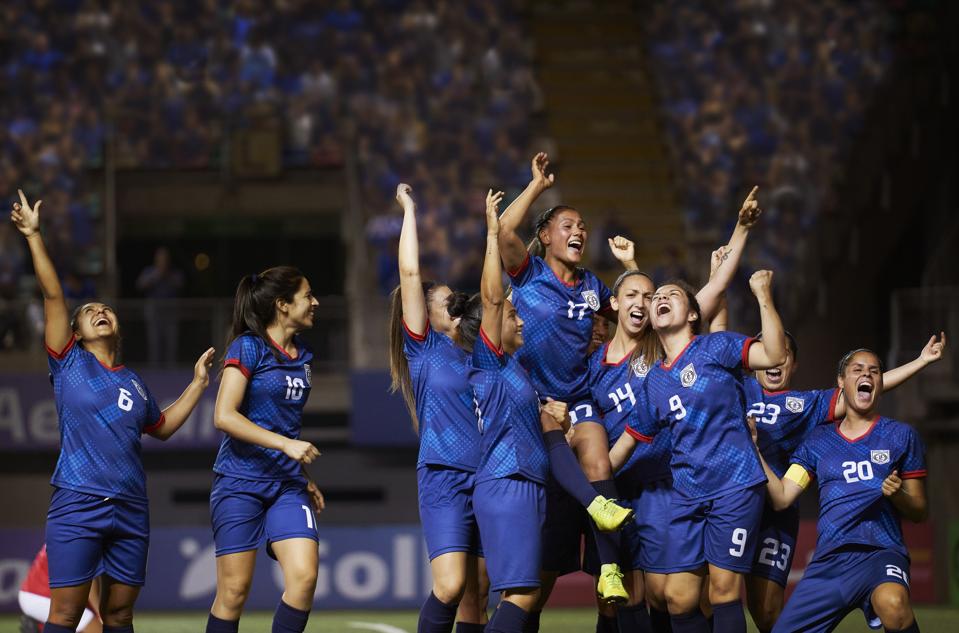
Sports sponsorship long followed a predictable playbook. Brands spent heavily on star male athletes, buying visibility and cultural relevance in a single move. The approach delivered reach, optimized for exposure rather than connection. In the process, it left women’s sports underfunded, undervalued and often overlooked altogether.
That model has shifted. As investment pours into women’s sports, a new class of brands is entering earlier, thinking longer term, and even scaling alongside the leagues themselves rather than waiting for them to mature.
Advertisement
Last year, McKinsey & Company estimated a $2.5 billion opportunity in women’s sports. Sponsorship dollars are already accelerating behind it. The WNBA entered the 2025 season with a record 45 sponsors, including 14 added across 2024 and 2025 alone. Meanwhile, increased sponsorship traction across the WNBA and NWSL added more than $250 million to the women’s sports market in 2024. As of September 2025, the NWSL had 16 active league-level sponsors, the highest in league history.
For brands, increasingly, the question is not who you sponsor, but where you embed. The new model is less about reaching an audience once and more about embedding into an ecosystem over time.
A Different Kind Of Bet
The structure of sports sponsorship in women’s leagues differs significantly from the legacy model. Instead of defaulting to high-cost, single-athlete endorsement deals, brands are experimenting with a broader mix of partnerships: league-level integrations, community investments, co-branded product drops and in-venue experiences designed to build deeper engagement over time.
Advertisement
Female-founded companies like Dagne Dover have made that intentional shift. Their partnership with League One Volleyball reflects a belief in how the future of women’s sports will be built.
LOVB itself was designed differently from the start. Rather than launching as a top-down professional league, it was built “club up,” connecting a national network of youth volleyball programs to a professional pathway. The result is an integrated network that spans middle school athletes, elite development and the pro level, creating both a talent pipeline and a deeply engaged fan base rooted in community.

On the court: Dagne Dover Founders (Jessy Dover, Deepa Gahndi and Melissa Mash) with Danielle Scott (Head of Pro Talent Acquisition at LOVB and 5x Olympian) and Michelle Chatmansmith (Pro Recruiting Coordinator at LOVB)
Courtesy of Dagne Dover
When Dagne signed on, it marked the company’s first formal sports league deal in its 13-year history. The brand is integrating across that full pipeline, from youth development programs to professional athletes to the families and communities that fuel the sport’s growth.
Advertisement
“Elevating women’s sports has been important to us because they don’t get as much funding, they don’t get as much visibility,” said Melissa Mash, cofounder of Dagne Dover, during a video call. “We are builders, just like how [LOVB] is building something, new, new leagues, new teams. We wanted to support something that we felt was from the ground up.”
This is what distinguishes many of today’s women’s sports deals. They are not purely media buys or endorsement contracts; they are strategic plays, often combining:
-
Product integration with athletes
-
Retail and co-branded merchandise
-
In-arena activations and fan experiences
-
Community and youth-level engagement
LOVB’s model makes that possible. Its reach extends beyond game-day audiences into year-round participation, giving brands repeated, meaningful touchpoints with athletes and consumers at different stages of their journey.
Why Early Investment Matters
Before formally entering league sponsorships, Dagne had already seen growing interest from female athletes across professional sports. Players from teams including the U.S. women’s national soccer team were already carrying Dagne products while traveling for competition, often without paid partnerships.
Advertisement
That organic adoption helped the founders recognize an overlap they had not initially designed for.
“When the women’s U.S. soccer team started to come to us and say, ‘We love your bags,’ something clicked,” said Jessy Dover, cofounder of Dagne Dover. “I realized at that moment how the athlete’s lifestyle is actually very similar to ours. They’re just not going to the office, they’re going to practice or training.”
That realization reshaped how the company thought about both product design and sports partnerships. Athletes were not simply influencers or endorsement vehicles; they were existing customers whose daily routines mirrored the needs of Dagne’s broader consumer base: organization and transitioning between multiple roles throughout the day.
That insight is now shaping future collections, from functionality to color palettes, as the brand leans further into sports and travel.
Advertisement
At the same time, the founders viewed LOVB as an opportunity to invest early in a league still establishing its identity and infrastructure.
“When you build with them, they remember that you were there at the beginning,” said Deepa Gandhi, cofounder of Dagne Dover. “To be able to stand behind something that is in their second season, going into their third season, that’s truly building a community and world and ecosystem around them, that felt very compelling to all of us.”
The Rise Of Values-Based Sponsorships
But Dagne is not alone in rethinking what sports sponsorship can look like.
Another example is Bobbie, the organic infant formula brand that became the official infant feeding partner of the National Women’s Soccer League. Rather than focusing exclusively on elite athletic performance, Bobbie built its partnership around the realities of parenthood and the growing number of professional female athletes openly navigating motherhood alongside their careers.
Advertisement
“We see our NWSL partnership as a bit of our brand intervention,” said Kim Chappell, chief brand officer at Bobbie. “Parents, who represent a massive portion of that fan base, have largely been ignored by traditional sports sponsors. Our parents are in the stands, our parents are on the field, our parents are on the sidelines, and so our logo should be a part of that and our brand dollars should be a part of that ecosystem.”
That framing highlights how brands are increasingly aligning with values and life stages, not just audience demographics.
Sponsoring The Athlete And The Mother
For Bobbie, whose customer base largely consists of new mothers, the partnership aligned naturally with the NWSL’s advocacy around paid leave, equal pay and support for players returning to the field after childbirth.
Advertisement
“The NWSL has done such a beautiful job of championing women and equality in women’s sports and fair pay and paid leave,” Chappell expresses. “That fight for support in their journey into motherhood, in their career, is exactly what we stand for at Bobbie.”
Last year, the company launched its “There’s No Scoreboard In Motherhood” campaign alongside soccer icon Alex Morgan as she transitioned into becoming a mother of two and prepared for retirement from professional soccer.

Alex Morgan partnered with Bobbie in their “There’s No Scoreboard in Motherhood” campaign after the birth of her second baby.
grace rivera for bobbie
“It’s not only about supporting the women on the field, but also saying we support you when you need to take a pause, or you’re transitioning to the next moment of your career,” Chappell said.
Advertisement
Like Dagne, Bobbie is approaching sponsorship less as a transaction and more as a long-term cultural investment. The brand’s NWSL activations have included community baby showers.
From Transactions To Cultural Investments
Instead of reaching a fan once, brands are embedding themselves into a lifecycle. Perhaps the most defining element of this strategy is timing.
Instead of waiting for leagues to prove scale, brands like Dagne and Bobbie are entering early, when cultural and commercial value is still being defined. That early positioning can translate into long-term brand equity, particularly in emerging categories where loyalty is still forming.
Advertisement
“People who are passionate about women’s sports really appreciate and pay attention to the brands that are supporting them,” Mash noted.
That attention eventually becomes something more valuable: affinity.
As women’s sports continue to scale, the brands that win may not be those that spend the most, but those that invest earliest and most intentionally. In women’s sports, the smartest sponsorships are no longer chasing the spotlight. They are helping build the stage.
MORE FROM FORBES
FORBES | By Cheryl Robinson
This Leadership Style Eliminates Decision Bottlenecks—Context Engineering
FORBES | By Cheryl Robinson
NFL Draft Playbook For Leaders—How To Create Defining Moments At Work
FORBES | By Cheryl Robinson
Energy Leadership—The New KPI Driving Team Performance
This article was originally published on Forbes.com
#Smart #Brands #Betting #Big #Womens #Sports