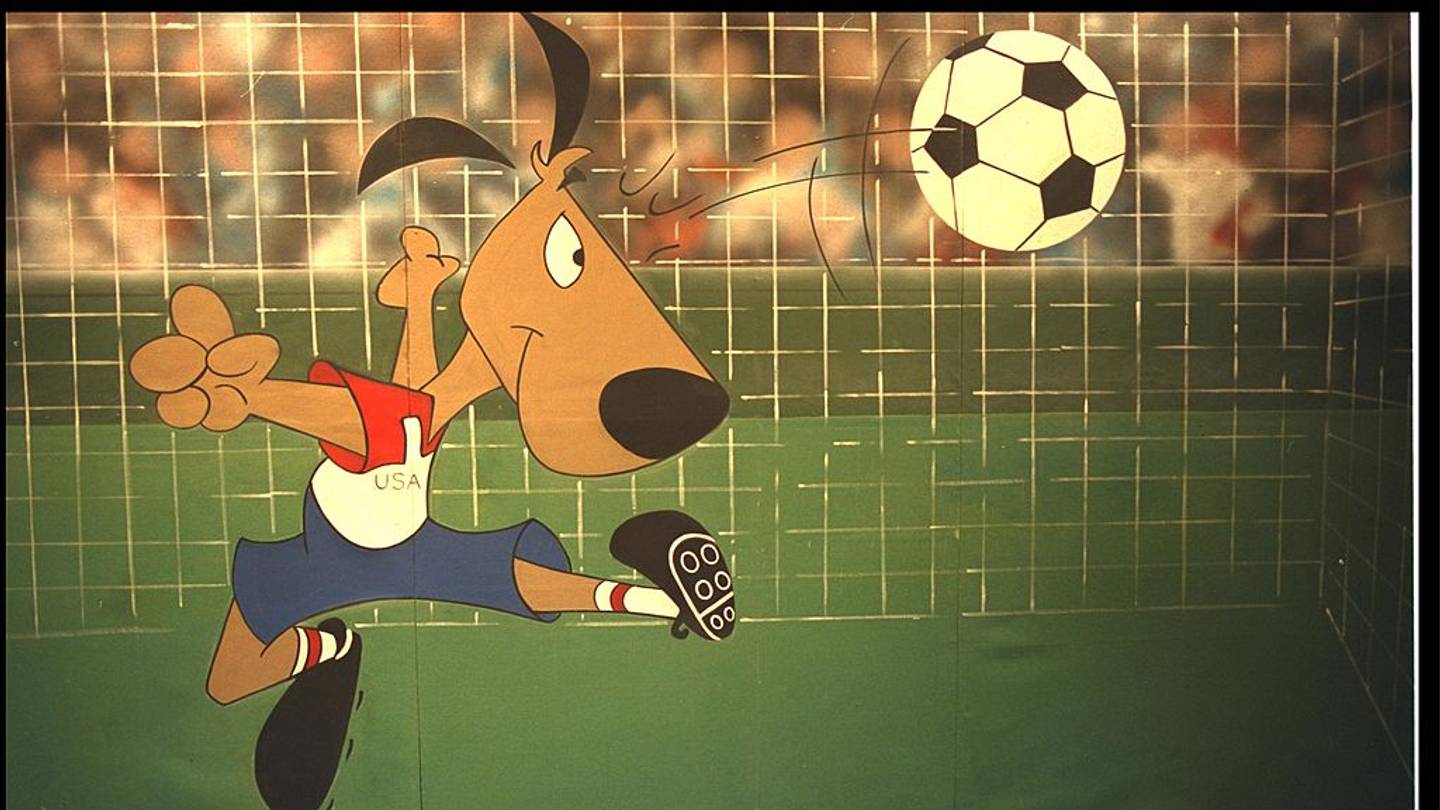
Much like there is a pantheon of great World Cup superstars, there is also a pantheon of great World Cup mascots, where Striker the animatronic dog most certainly belongs.
Flash back to 1994, the last time soccer’s biggest tournament unfolded on U.S. soil. Bill Clinton was president, Forrest Gump was in movie theaters and a dog dressed up in a U.S. men’s national team shirt was bleeding into pop culture.
Striker started out as just the official mascot of the 1994 World Cup but quickly took over the tournament. From commercials and advertising campaigns to merchandise and children’s toys, the dog transcended the sport, capturing the hearts of even the most casual soccer fans throughout the United States.
Brazil might have won the showpiece event that summer, defeating Italy in a penalty shootout to claim a fourth World Cup title, but Striker was the real winner of the 1994 edition—and he didn’t even log a single minute on the pitch.
Striker Breaks the Mold

Mascots are such a staple of sports, especially throughout the United States, that it’s hard to envision a time where they didn’t exist. But there is a first for everything, and World Cup Willie was the original World Cup mascot back in 1966.
The lion, wearing a Union Jack shirt, was the face of the World Cup hosted—and won—by England. World Cup Willie was a pioneer, but not exactly a trendsetter. The mascots that followed were not animals, but rather a variety of different characters.
West Germany introduced two young boys “Tip” and “Tap” as the mascots for the 1974 World Cup. Naranjito, the face of the 1982 World Cup hosted by Spain, was a talking orange. Mexico followed suit four years later with chili pepper named Pique. Italy went completely outside the box in 1990, debuting Ciro, a soccer-playing stick figure.
It wasn’t until Striker came along in 1994 that the mold was officially broken, bringing an animal back to represent the tournament for the first time in 28 years.
The Public Has Its Say

When it came time for choosing the mascot for the 1994 World Cup, the power was put in the hands of the people. Americans got to vote for their preferred candidate, and they chose Striker.
It’s really no wonder the dog came out on top; just take one look at him. Created by Warner Bros. Animation, Striker wore a red and white top, with USA 94 written across the chest, and blue shorts. The outfit alone embodied U.S. patriotism, especially with his red and white socks completing the look.
Then there’s his friendly, approachable face. Who doesn’t love a cute dog? Plus, it helped that his cartoonish look appealed to both adults and kids.
It was an open goal for Warner Bros. Animation and FIFA, and they did not miss.
Striker Becomes Larger Than Life

Just having a personable, recognizable mascot was likely the main objective for FIFA. After all, the World Cup was about (spoiler) soccer. The 24 teams chasing glory in the United States took center stage … but they had a guest under the spotlight.
Striker and his floppy ears took over. The dog, dubbed the “World Cup Pup,” was suddenly starring in his own commercials, promoting the World Cup by showing off his ability to flick a soccer ball onto his long snout and bounce it up and down, much like a player showing off his ball control on the pitch.
The mascot was also on a wealth of merchandise, including shirts, cups, glasses, magnets and pins. There were Striker-themed toys, as well as Striker stuffed animals. Some of the items, now considered vintage, are even still available for purchase on secondhand sites.
All the while, Striker fulfilled his prime mascot duties—attending matches. Individuals had to don the mascot’s heavy wool costume under the blaring heat of a United States summer, peering out through eye holes in the dog’s snout as they took picture after picture with adoring fans while the sounds of World Cup games unfolded in the background.
It was safe to say that Striker had evolved into something much bigger than just a mascot. The dog became a symbol not only for the tournament, but for the United States and soccer as a whole.
Striker’s Legacy

It’s been 32 years since Striker became the face of the 1994 World Cup, but the dog still has his paw prints all over soccer’s biggest tournament. After his popularity, animals became the norm for World Cup mascots.
Goleo VI was the lion that took center stage in 2006, followed by Zakumi the leopard four years later when South Africa hosted the World Cup. Russia then introduced Zabivaka the wolf in 2018.
Fast forward to 2026 and the United States, Canada and Mexico unveiled three mascots—all animals—for this summer’s showpiece event. Maple the moose paid homage to Canada, Zayu the jaguar represented Mexico and Clutch the bald eagle belonged to the U.S.
The three characters were met with mixed reactions, many fans finding them too predictable and obvious. They lacked a certain creativity expected for the biggest World Cup of all time, featuring 48 teams for the first time in history.
It’s a wonder Striker wasn’t met with the same criticism, considering there was nothing extraordinary about the dog on the surface. Yet he was simply a phenomenon—a rare breed, if you will—in a country that was just beginning to truly welcome soccer into their homes, where it would remain all these years later.
READ THE LATEST WORLD CUP NEWS, ANALYSIS AND INSIGHT FROM SI FC
 Add us as a preferred source on Google
Follow
#Dog #Face #World #Cup