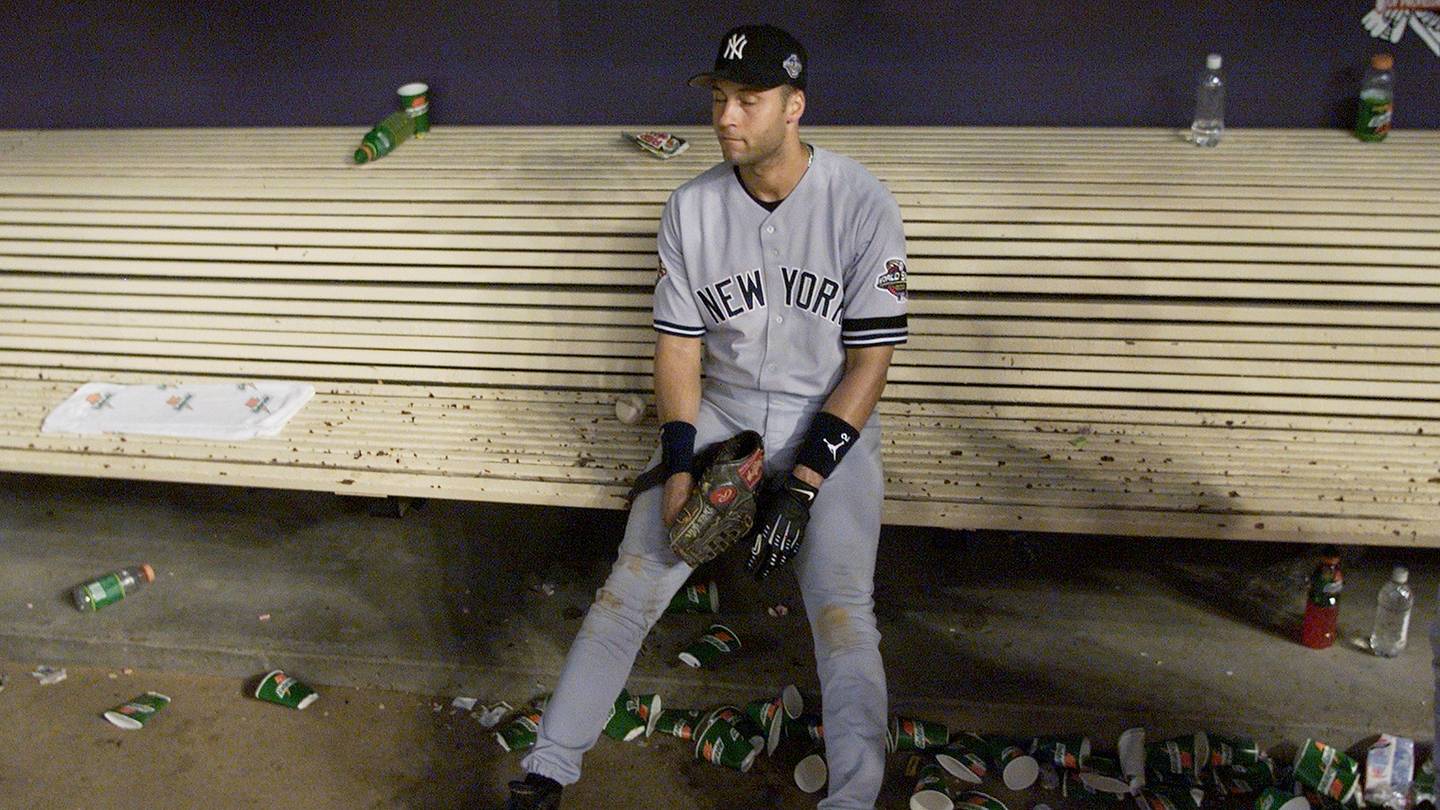
It was 17 minutes after 9 p.m. when the baseball landed as delicately as a dove in the outfield grass. The most emotional, nerve-jangling, cathartic fortnight of baseball ever played ended softly, like Haydn’s Symphony 45, the Farewell Symphony, which concludes with two lone violinists, all that remains after the other orchestral players have left the stage, playing quiet, plaintive notes.
Having watched the baseball loop maddeningly over his head, New York Yankees shortstop Derek Jeter trudged toward the first-base dugout as the Arizona Diamondbacks celebrated the ninth-inning single by Luis Gonzalez that won the 2001 World Series for Arizona. Up 2–1 with Mariano Rivera on the mound, the Yankees had been two outs from winning a fourth straight World Series. When Jeter reached the dugout, he stopped and turned around to see the euphoria Gonzalez’s plucked violin string of a hit wrought.
“I remember walking off the field, sitting in the dugout for a little bit,” Jeter says. “And it almost is funny because I have kids now, right? It’s almost like you’re a kid and you’re looking out the window, and you’re seeing all the other kids play, and they’re playing with your toy. You know what I mean? And you’re like, Well, hold on a minute. We’re supposed to be out there playing with it.
“And then just going into the clubhouse … and I was just sitting there. I mean, you’re stunned. You’re stunned. Yeah. Stunned.”
It was the first time the Yankees of Jeter, Rivera, manager Joe Torre and the rest of the modern dynasty lost a World Series. The plane ride back to New York marked the end of a grueling 33-day stretch in which the Yankees flew 19,614 miles.
“It was quiet,” Jeter says of the flight. “I remember it was quiet. I think initially the emotion was shock. You’re completely shocked when you lose. And then it’s disappointment. That’s the next emotion.
“Disappointment where we felt like we let people down. I think that’s when it sort of sunk in. We’re headed back home to New York and feeling like we let everyone down. It was a quiet trip. It was like you just … at least I did … I felt like we’d let down not just Yankee fans, but you felt like you’d let down all of New York.”

It had been only 54 days since Sept. 11 and the worst terrorist attack on American soil. Ground zero still smoldered with the ruins of the Twin Towers. The Yankees had come to represent the city in its twin rawness of grief and determination.
Twenty-five years later, the 2001 World Series—a series he lost—resonates more deeply with Jeter than most any career highlight. It was bigger than the team. Bigger than the title that slipped away. Bigger than baseball.
“It seems like it’s a long time ago, but then again, the events that took place are still fresh in my mind,” he says. “Because it’s one of those memories that sticks with you. I mean, look, there’s a lot of things that have happened in my career. I did a documentary, and they’re asking me questions about things that happened and, quite frankly, I can’t remember.
“But being in New York around that time, those memories stick with you. So even though it was 25 years ago, it’s something that you absolutely never forget. You never forget the feel. You never forget the smell. You never forget the people walking around Manhattan. Manhattan’s known for noise and traffic and horns and people talking. And people were just walking through the streets saying nothing. It was really bizarre.
“But, the interesting thing is even to this day, if I run into people, Yankee fans, New Yorkers, they’ll mention how great that World Series was—and no one mentions the fact that we lost. It’s really fascinating because Yankee fans are like no other. It’s, ‘You win a World Series or it’s a failure,’ which I 100% agree with. But in that particular World Series, no one I run into mentions the fact that we lost.”
It was an iconic series for Jeter many times over. In Game 3 of the ALDS, he made his famous “Flip Play,” redirecting a wayward outfield relay throw with a flick of the wrist to prevent Jeremy Giambi of Oakland from scoring the tying run. In Game 5 of that series, he flipped himself, tumbling head over heels into the stands (and injuring his hip) to catch a pop fly by Terrence Long.
Before Game 3 of the World Series, he playfully counseled President Bush in the Yankees’ batting cage under the right field stands about his upcoming ceremonial first pitch. “Better not bounce it,” Jeter told the president. “They’ll boo you.”

That night marked the first mass public gathering in New York since the attacks. No one knew if they were in the safest place in the world because of the massive security presence, or the most dangerous, given prevailing threats of attacks and the syzygy of the American institutions of the presidency, baseball and Yankee Stadium. Snipers patrolled the stadium’s rooftop. A seventh umpire in the pregame exchange of lineup cards was a Secret Service agent in disguise.
Nick Trotta, an assistant special agent in charge of the presidential protection division of the United States Secret Service, stood on the grass between the first-base line and the World Series logo. Earlier he had told President Bush, “Sir, I am always confident in my job. And tonight I am so confident that there is not one person in this place that would ever allow anything to happen.”
When the president bounded from the dugout, the crowd erupted in prideful delight. Underneath his suit, Trotta could feel the goosebumps on his arm. He did all he could not to break down. His job was to scan the crowd for anything awry. He saw people crying.
Says Jeter, “Politics right now are so polarizing. And I’m not getting political at all. But politics at that particular moment in time, it didn’t make a difference. Republican, Democrat, independent … didn’t care what race, religion … President Bush represented us as a country. I think everyone felt that when he was there. And that’s not always the case when you talk about politicians, you know?”
Bush had bounced a first-ball pitch earlier that season in Milwaukee when his landing foot slipped. He had made the mistake of wearing leather-soled dress shoes then. He was determined it would not happen again. For Game 3 he wore a more rugged, rubber-soled shoe. Eschewing a temporary rubber on the slope of the mound, head high, chest out, he climbed to the plateau. He heaved a beautiful, emphatic strike.
Before the series, Arizona pitcher Curt Schilling brushed aside questions about the Yankees having aura and mystique on their side at the stadium. “Aura and Mystique?” he scoffed. “They’re exotic dancers at a nightclub.” That prompted one prescient Yankees fan to hang a banner from the upper deck: “Aura and Mystique, Appearing Nightly.” It was truth in advertising.

The three nights in the Bronx were episodic classics of New York resilience: three one-run wins, including two walkoffs, one of them on an after-midnight home run by Jeter as the calendar flipped to November.
“It was the only time in my career I jumped up and landed on home,” Jeter says. “Only time in my career. And that’s where I messed up my foot. It wasn’t broke. But it wasn’t feeling good.”
Jeter suffered a deep bone bruise. He went 2-for-11 the rest of the series. By the time he took the field for the ninth inning of Game 7, he was limping noticeably. When Mark Grace started the inning with a single, the digital ballpark clock read “9:11.”
The next batter, Damian Miller, bunted. Rivera, an expert fielder, had a force play in order at second base. His throw sailed wide, like an errant two-seamer. Jeter, hobbled by his Mr. November stomp on home plate, could not steady himself to stay on the base and corral the throw. The rally was set in motion. It was 9:17 when the last note of the Farewell Symphony sounded. A violin string plucked. A heartstring snapped.
Twenty-five years later, the memory of what should rank as one of the most wrenching defeats of Jeter’s career summons more pride than pain.
“Man, I was proud, obviously representing the Yankees,” Jeter says. “But we felt as though we were representing all of New York. And so, there was a level of disappointment, but at the same time there was pride.
“I just realized that not too long ago. Someone was asking me about it, and I was like, ‘Man, you know, people mention ‘Mr. November’ and ‘I was at the games in New York’ and ‘What a series’ … And no one says, ‘But you lost the series.’ Now I look at it that way because when you’re done you look back and you think about all the opportunities you had to win and didn’t come through. But this one, no one brings it up that we lost. Amazing.”
 Add us as a preferred source on Google
Follow
#Derek #Jeters #Meaningful #World #Series #Lost