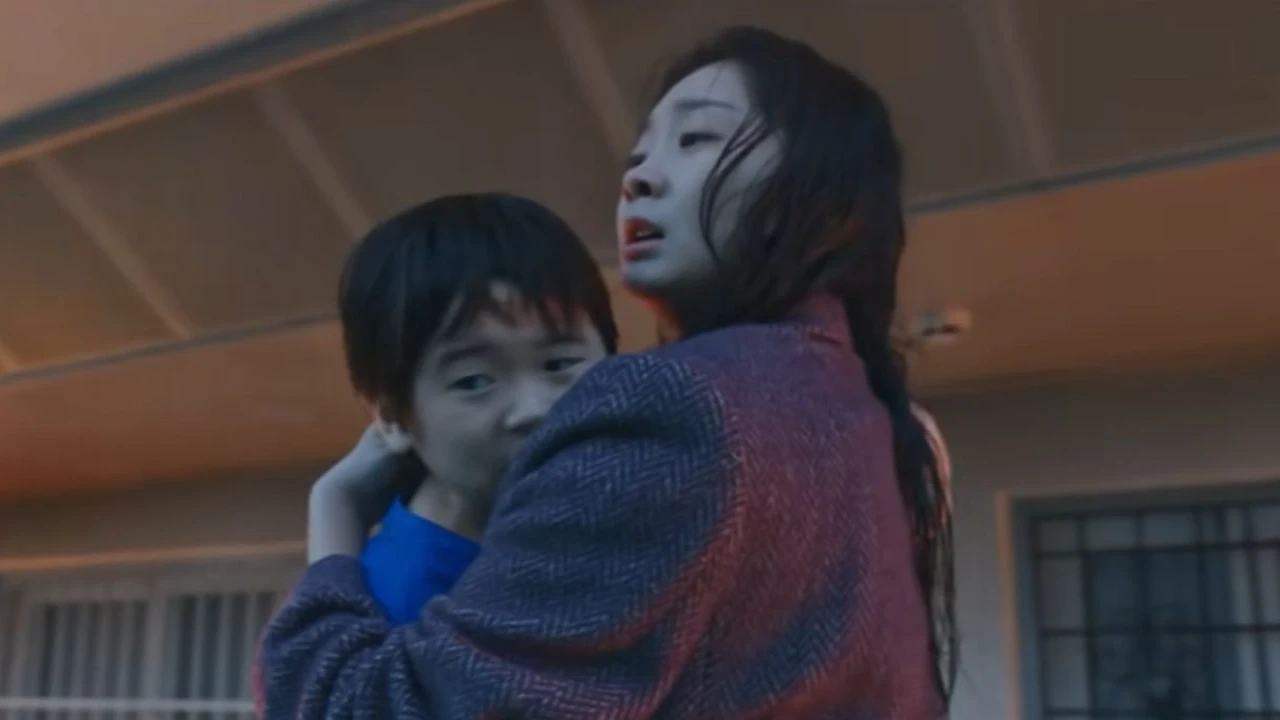
Netflix’s The Great Flood starts as a survival thriller but ends as a layered sci-fi drama. Starring Kim Da-mi as An-na and Park Hae-soo as Hee-jo, the film slowly reveals that the disaster is only part of a much bigger experiment. The ending raises a key question: did An-na really survive the flood, or had humanity already reached its end before the final scene?
The Great Flood ending explained: What is real and what is not?
At first, the film shows a sudden global flood caused by an asteroid impact in Antarctica. An-na struggles to escape a submerged apartment building with Ja-in, the child she has raised as her son. This part of the story is real. The flood is actually happening, and governments already know that Earth cannot be saved.
The twist comes after An-na reaches the rooftop and is taken away by a research team. From this point, the film shifts from physical survival to psychological testing. An-na works for a secret organization trying to preserve humanity through artificial intelligence. Ja-in is revealed to be an advanced AI, not a biological child.
The flood is then used as a controlled test environment. Scientists want to know if artificial beings can develop genuine emotions. Logic already exists in AI. Emotion does not.
Here’s why the simulation matters more than the flood
An-na is taken to a space laboratory, where she learns about the Emotion Engine, a system designed to give AI real emotional depth. Instead of programming emotion, An-na chooses to experience it herself.
She enters a simulation that forces her to relive the flood repeatedly. Each time she fails to save Ja-in, the day resets. At first, she lacks key memories. Over multiple loops, she begins to remember her past, her loss, and her promise to never abandon Ja-in.
The experiment is not about saving the world. It is about proving that love, memory, and sacrifice can exist inside artificial systems.
In the end, An-na remembers everything. She searches differently, resists the guards, and finds Ja-in hiding where he always goes when scared. This completes the test. The simulation ends, and An-na and Ja-in appear together on a spacecraft looking back at Earth.
The film never confirms whether An-na is still human or a recreated being built from her memories. That ambiguity is intentional. The Great Flood suggests that humanity may survive through emotion, even if human bodies do not.
The ending makes one point clear. Survival without emotion is meaningless. Whether An-na escaped the flood or not matters less than what survived with her.
ALSO READ: The Odyssey Trailer OUT: Matt Damon, Anne Hathaway, and Tom Holland Give Way to Christopher Nolan’s Epic
#Great #Flood #Explained #Anna #Escape #Disaster #Humanity #Long