Evernorth is set to become a publicly traded XRP treasury company after shareholders of blank-check firm Armada Acquisition Corp. II approved their proposed business combination.
The deal is expected to close on Oct. 7, with shares of the combined company set to begin trading on Nasdaq under the ticker XRPN the following day, subject to remaining closing conditions.
The vote clears a key hurdle after Evernorth filed its Form S-4 registration statement with the US Securities and Exchange Commission in March. The registration statement was declared effective in August, leaving shareholder approval as one of the remaining steps before the Nasdaq listing.
At closing, Evernorth expects to hold about 473 million XRP, which it says would make it the largest publicly traded pure-play XRP treasury company.
According to Thursday’s announcement, the transaction is expected to raise about $300 million in gross cash proceeds, including $225 million from related private placements, $30 million in convertible note financing and roughly $48 million from Armada II’s trust. Investors have also contributed XRP directly to the transaction.
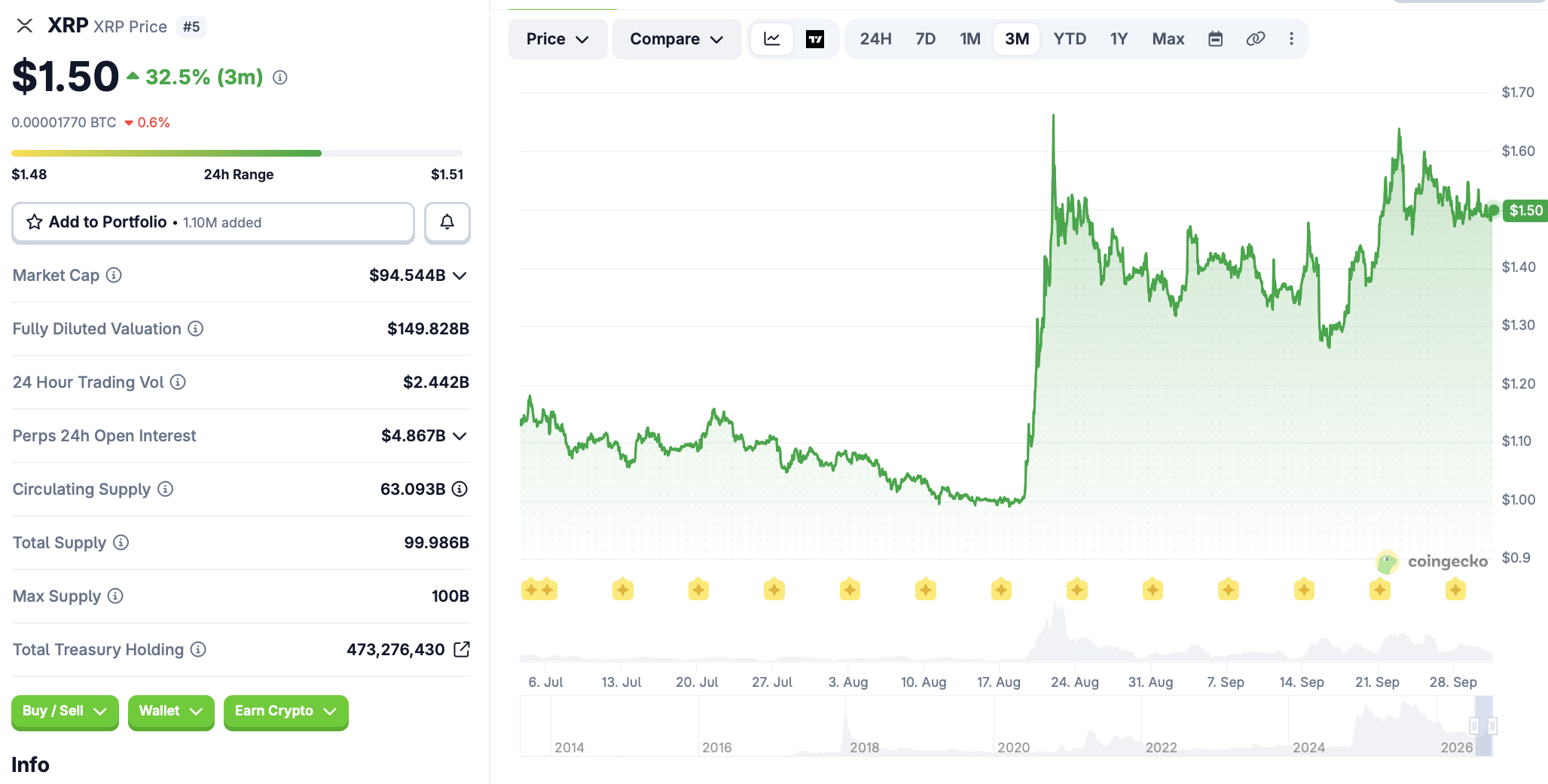
XRP was trading at about $1.50 at the time of publication, according to CoinGecko data, putting Evernorth’s expected 473 million-token treasury at roughly $710 million.
Evernorth’s investors include Ripple, Kraken, Pantera Capital, SBI Group, Arrington Capital and GSR. It plans to grow its XRP holdings per share through yield strategies, participation in the XRP ecosystem and capital markets activities.
Related: Ether, XRP ETF inflow streaks end as Bitcoin funds rebound
Crypto treasury SPACs face market headwinds
Evernorth’s planned Nasdaq debut comes as other crypto companies have pursued SPAC mergers to reach US public markets, with markedly different outcomes this year.
Tokenization firm Securitize began trading on the New York Stock Exchange in July after completing its merger with Cantor Equity Partners II, while CoinShares made its Nasdaq debut in April following a $1.2 billion merger with Vine Hill Capital Investment Corp.
However, crypto treasury companies have faced setbacks. Ether Machine scrapped its planned merger with Dynamix in April, citing unfavorable market conditions and ending plans to launch a $1.5 billion yield-bearing Ether fund through the deal.
In July, Adam Back’s Bitcoin Standard Treasury Company and Cantor Equity Partners I also scrapped the original terms of their proposed merger and postponed a shareholder vote indefinitely while negotiating a deal that would “better reflect market conditions.”
Magazine: Stablecoins can drain from banks and nations at lightning speed
#Evernorth #Wins #Shareholder #Vote #Nasdaq #XRP #Treasury #Listing
]]>TCU did not get the Big 12 opener it wanted. Now, the Horned Frogs return home looking for a response against undefeated BYU, with the KillerFrogs staff divided on what Saturday will bring.
The Frogs enter at 2–2 following a 21–13 loss at UCF. No. 10 BYU arrives at 3–0 after an open week, presenting another significant challenge for a TCU team still searching for its first conference victory.
As our BYU scouting report details, the Cougars have shown they can win in different ways. TCU will need a more complete performance to send them home with their first loss.
The questions facing the Frogs are familiar. Can they establish a running game, protect the football and avoid the mistakes that have stalled promising possessions? Those concerns are central to what must change for TCU football as the conference schedule continues.
For the second consecutive week, our staff has mixed expectations. Some see an opportunity for a home upset. Others expect BYU to take control.
The Cougars sit atop our latest Big 12 football power rankings, but Saturday gives the Frogs a chance to change the conversation.
Let’s see who the KillerFrogs staff has picked to win.
TCU vs. BYU Score Predictions
Aiden Reed (2–2, one closest prediction): TCU 27–24
Baileigh Sheffield (2–2): BYU 27–24
Emma Swinney (2–2): BYU 28–17
Jackson James (2–2): BYU 42–13
Jason Phillips (2–2): TCU 24–21
JD Andress (2–2, one closest prediction): BYU 42–17
Michael Bara V (2–2): BYU 35–7
Nathan Cross (2–2): TCU 28–27
Ryann Zeller (2–2): BYU 21–13
Seth Dowdle (3–1): BYU 28–10
Skyler Gerard (2–2): BYU 36–24
Tom Burke (3–1, one closest prediction): TCU 31–28
Sean Foushee (2–2): BYU 38–27
Tori Couch (2–2, one closest prediction): BYU 35–20
Ten staff members picked BYU, while four chose TCU. Every prediction favoring the Horned Frogs has them winning by three points or fewer.
Why the KillerFrogs Staff Picked TCU or BYU
TCU’s running game, offensive consistency and ability to avoid mistakes shaped several of this week’s predictions. For those picking the Frogs, playing at home offers a reason to believe a better performance is possible.
TCU can’t run the ball right now; the team just isn’t in a good sequence. BYU is one of the best teams in the country. They will show that on Saturday.
Michael Bara V
I think with the bad weather conditions mixed with some issues with TCU’s offense, BYU will win with the solid team they have coming into the game in Fort Worth.
Skyler Gerard
BYU is coming off a bye, and they have looked sharp on all 3 units. TCU makes too many mistakes, and the Cougars will capitalize on any opportunities they get.
Jackson James
It’s gonna be a rainy night in Fort Worth, and conditions won’t be good for passing situations. The Frogs have struggled to run the ball effectively. BYU dominates TCU for the second year in a row
JD Andress
I genuinely just have a feeling about this one. I think the team plays way better and feels more comfortable at home. I think BYU will kind of overlook this game with how the season has gone for TCU so far, and I think TCU catches them off guard in this one
Aiden Reed
Our staff members are not the only Frogs weighing in this week. The latest TCU Legends Picks panel brings another set of perspectives to the weekend’s games.

KillerFrogs Staff Prediction Standings
Seth Dowdle and Tom Burke lead the staff with 3–1 records entering the BYU game. The remaining participants are 2–2.
Aiden Reed and Emma Swinney each predicted a 21–14 TCU victory last week. Although their scores were close to the final numbers, both picked the wrong winner.
Tom earned the closest-prediction credit with his 24–10 UCF pick, seven combined points away from the Knights’ 21–13 victory. Under our scoring rule, a staff member must pick the winning team to earn closest-prediction credit.
JD Andress, Tom Burke, Aiden Reed and Tori Couch now each have one closest-prediction credit.
What Is Your TCU vs. BYU Prediction?
Will the Frogs respond at home, or will the Cougars remain unbeaten?
This matchup comes with plenty of history and plenty of opinions, as our Dear BYU letter makes clear. Now it is your turn to make a pick.
Share your predicted winner and final score in the KillerFrogs Fan Forum.
Stay connected with TCU Horned Frogs On SI for the latest TCU news, analysis and recruiting coverage. Join the conversation in the KillerFrogs Fan Forum, follow KillerFrogs on X and Facebook, and subscribe to The Weekly Croak for Horned Frogs news delivered to your inbox.
 Add us as a preferred source on Google
Follow
#TCU #BYU #Score #Predictions #KillerFrogs #Staff
]]>Name: Drishyam: The Conclusion
Director: Abhishek Pathak
Cast: Ajay Devgn, Tabu, Jaideep Ahlawat, Shriya Saran, Rajat Kapoor, Prakash Raj, Ishita Dutta, Mrunal Jadhav, Kamlesh Sawant, Saurabh Shukla, Neha Joshi, Ramchandra Singh, Samvedna Suwalka
Writer: Abhishek Pathak
Rating: 4/5
Plot
Drishyam: The Conclusion continues the story of Vijay Salgaonkar, played by Ajay Devgn, and his family as the consequences of the events from the previous films continue to haunt them. This time, the stakes are considerably higher, with Vijay facing a formidable new challenge that threatens to expose everything he has painstakingly protected. The narrative builds towards the inevitable confrontation between Vijay and the forces determined to uncover the truth.
SP Crime Branch Rajveer Singh Tomar, portrayed by Jaideep Ahlawat, makes a dynamic entry to search for Sameer Deshmukh’s
culprit and punish Vijay Salgaonkar. Apart from him, Meera Deshmukh, played by Tabu returns with an intensified desire for vengeance to end Vijay once and for all.
What Works
The writing and direction are easily among the film’s strongest aspects. Director Abhishek Pathak wisely avoids repeating what has already worked. Instead, the narrative introduces a fresh layer to the central conflict and gradually builds towards the inevitable confrontation. The screenplay keeps the suspense alive while allowing the emotional stakes to remain at the heart of the story.
The first-half confrontation between Ajay Devgn and Jaideep Ahlawat stands out. Their contrasting screen energies create tremendous tension, making their exchanges among the most memorable portions of the film. The courtroom sequences are equally effective, with the opening sequence involving Prakash Raj, Devgn and his family immediately establishing the stakes. The climax is another major strength. It delivers on the questions surrounding the story and delivers a fitting conclusion. The background score further elevates the suspense, adding intensity to several crucial moments.
What Doesn’t Work
The first half feels slightly slow-paced and takes some time to gather momentum. That remains the only noticeable drawback in the film. However, the narrative quickly picks up pace in the second half, more than making up for the initial sluggishness.
Acting Performances
Ajay Devgn once again proves why Vijay Salgaonkar remains one of his most memorable characters. The fact that he remains amongst the rare actors who can also act with their eyes is beyond commendable. His controlled performance communicates the character’s intelligence, fear and determination without relying on exaggerated expressions. His pre-interval confrontation with Jaideep Ahlawat is particularly impressive.
Jaideep Ahlawat is terrific and brings a completely different energy to the Drishyam universe. His performance is restrained, authoritative and menacing without becoming theatrical. His chemistry and confrontations with Devgn provide the film with some of its strongest dramatic moments.
Tabu is fabulous, bringing anger, pain, determination and revenge to her character with conviction. Prakash Raj adds considerable gravitas, while Shriya Saran takes us back to her character Nandini’s innocence. Rajat Kapoor brings dignity to his role, and Kamlesh Sawant makes an impact and delivers the comic punch whenever he appears. Ishita Dutta and Mrunal Jadhav deliver decent acts despite having limited material to work with.
Final Verdict
Drishyam: The Conclusion delivers where it matters most right from the writing, performances to building the tension, and climax. Abhishek Pathak successfully expands the franchise without losing its core identity, while Ajay Devgn remains its undisputed emotional anchor.
Jaideep Ahlawat’s arrival adds fresh conflict, Tabu continues to command attention, and the courtroom and climax sequences provide the required dramatic highs. With a satisfying finale, Drishyam The Conclusion emerges as a strong concluding chapter.
Download Pinkvilla Buzz now with one click: Pinkvilla Buzz
ALSO READ: Drishyam 3 Advance Box Office Update: Ajay Devgn starrer cross 2.40 lakh tickets at national chains, On course to Rs. 50 Cr Day one
#Drishyam #Conclusion #Review #Ajay #Devgn #Vijay #Salgaonkar #owns #screen #gripping #finale #mins #deliver #mindblowing #climax
]]>More than 50,000 Europeans have urged the European Commission to loosen restrictions on stablecoin rewards as part of its review of the bloc’s Markets in Crypto-Assets (MiCA) framework, according to crypto advocacy group Stand With Crypto EU.
The campaign came as the Commission closed its MiCA review consultation on Wednesday, with Stand With Crypto EU pushing for regulated stablecoin providers to be allowed to offer incentives including cashback, loyalty benefits and fee reductions.
The group said more than 50,000 supporters wrote to the Commission during the consultation, while more than 126,000 people have separately signed its petition calling for a more permissive EU approach to stablecoins.

Stand With Crypto EU campaign vehicle outside the European Parliament in Brussels, Belgium. Source: Stand With Crypto EU
MiCA prohibits issuers and crypto service providers from paying interest on stablecoins, a restriction Stand With Crypto argues puts the products at a disadvantage to bank deposits and other e-money products that can offer benefits to customers.
Stand With Crypto said the campaign generated more than six times the 8,221 responses submitted to the European Central Bank’s (ECB) digital euro consultation and far exceeded the 198 responses received during the Commission’s 2020 consultation on crypto rules.
Stand With Crypto calls for EU to compete with US
“We are calling on the Commission to use the MiCA review to allow regulated stablecoins to offer rewards to holders,” Stand With Crypto EU general manager Harry Pearce Gould told Cointelegraph.
Asked whether Europe should look to regulatory models outside the EU, Pearce Gould pointed to the US:
The US has made a clear choice to back stablecoins as the settlement layer for tokenisation. Europe doesn’t need to copy that, but it does need to compete with it.
He added that allowing rewards could help euro-denominated stablecoins gain adoption and compete with dollar stablecoins.
“Strong euro stablecoins matter for the euro’s global standing and the EU’s payment sovereignty,” he said.
Related: Binance’s EU services face scrutiny over licensing exemption: Report
EU central banks seek changes to stablecoin rules
The campaign comes as European central banks are pushing for broader changes to MiCA’s treatment of stablecoins.
In a Sept. 22 response to the European Commission’s MiCA review, the European System of Central Banks (ESCB) called for the existing prohibition on stablecoin interest to extend to lending, borrowing and staking arrangements that generate yield.
The ESCB also proposed replacing MiCA requirements that stablecoin issuers hold a minimum share of their reserves in bank deposits with liquidity thresholds. The central banks argued that the existing rules could strain lenders if a stablecoin run forced an issuer to rapidly withdraw deposits.
The ECB has separately highlighted a potential liquidity mismatch, noting in June that stablecoins settle around the clock while their reserve assets may still operate on traditional settlement timelines.

Source: European Central Bank
The proposals come amid broader concerns from the ECB over stablecoins’ potential impact on financial stability.
In May, ECB President Christine Lagarde warned that a shift of deposits from banks into stablecoins could weaken bank lending and monetary policy transmission, while arguing that Europe should instead prioritize tokenized financial infrastructure anchored by central bank money.
Magazine: Peter Brandt says Bitcoin may hit $600K by 2029, calls XRP a ‘fool coin’
#European #Crypto #Advocates #Challenge #MiCA #Stablecoin #Rules
]]>Alabama became the latest SEC program to join the Zahkir Muhammad sweepstakes this weekend.
The Crimson Tide offered Muhammad, an edge rusher from the class of 2030. He made the announcement on social media following his game day visit last weekend where the Crimson Tide defeated South Carolina 49-18 inside Bryant-Denny Stadium.
After a great game day visit blessed to have an offer from @AlabamaFTBL @crob45 @CoachSanders14 @iamcoachrock @ChadSimmons_ @benjaminwolk @BrettGreenberg_ @samspiegs @adamgorney @TomLoy247 @CharlesPower @CodyBellaire @GregBiggins @AllenTrieu @Jdsmith31Smith @yea_ala @SWiltfong_ pic.twitter.com/QWRBbs2IZI
— Zahkir THOR Muhammad (@Zah_Muhammad6) September 27, 2026
Muhammad has gained the attention of several Power Four programs as he has offers from LSU, Florida, Florida State, Georgia, Miami, North Carolina, Ole Miss, Oregon, South Carolina and Washington.
Standing at 6-foot-3, Muhammad is already proving to be a sought after prospect amongst the elites in the sport.
This is now the 12th player the Crimson Tide has offered in the class of 2030 and third offer to a player along the defensive front including fellow edge rusher Trey Kiles and defensive lineman Amari Tramell. Both Tramell and Kiles are also from the state of Alabama.
Following the productive weekend hosting game day visits, the Crimson Tide will now turn its attention to Mississippi State on Saturday as it goes on the road.
Alabama’s 2027 Recruiting Class
- 5-star – Quarterback – Elijah Haven – Baton Rouge, La.
- 4-star – Wide Receiver – Osani Gayles – Bradenton, Fla.
- 4-star – Running Back – Nigel Newkirk – Gainesville, Ga.
- 4-star – Quarterback – Trent Seaborn – Alabaster, Ala.
- 3-star – Edge – Jeremiah Beverly – Tuscaloosa, Ala.
- 3-star – Wide Receiver – Cedrick Simmons, Selma, Ala.
- 3-Star – Offensive Line – Stafford Willis – Arab, Ala.
- 3-star – Edge Rusher – Tyler Younger – Norcross, Ga.
- 3-star – Cornerback – Darrius White – Fairburn, Ga.
- 3-star – Running Back – Tai Phillips – Columbia, S.C.
- 3-star – Defensive Line – AJ Pauley – Mobile, Ala.
- 3-star – Kicker – Luke Cody – Lumberton, TX
- 3-star – Tight End – Michael Nnabuife – Baltimore, Md.
- 3-star – Tight End – Oakley Keegan – Liverpool, N.Y.
- 3-star – Defensive Lineman – Kavarris Duncan – Alpine, Ala.
Alabama’s 2028 Recruiting Class
- 4-star – Quarterback – Kingston Preyear – Alexander City, Ala.
- 4-star – Offensive Lineman – Anthony Blalock Jr. – Austintown, Ohio
- 4-star – Edge – Tysir Young – Middletown, De.
- 3-star – Cornerback – Braylen Gibbs – Knoxville, Tenn.
- 3-star – Quarterback – Charles Scott Jr. – Richmond, Va.
- 3-star – Linebacker – Dustin Henry – Laurel, Md.
Sign up to our free newsletter and follow us on Twitter/X, Facebook, YouTube, Instagram, TikTok for the latest news.
Add us as a preferred source on GoogleFollow
#Alabama #Latest #SEC #Program #Offer #Edge #Rusher #Class
Drishyam: The Conclusion (Drishyam 3), starring Ajay Devgn, Tabu, Jaideep Ahlawat, and Prakash Raj, recorded outstanding pre-sales at the box office. The movie sold around 4.05 lakh tickets in the top two national chains, PVR Inox and Cinepolis, for the opening day. That’s the second-biggest pre-sales of this year, only behind Dhurandhar: The Revenge. Among all-time pre-sales, the movie ranked at the 7th spot between War and Chennai Express.
As per Pinkvilla forecast, the movie is looking to take an opening of Rs. 50 crore, with a chance of even hitting Rs 55 crore on its opening day. All eyes now depend on Drishyam 3’s word-of-mouth. If the movie manages to receive positive reception, it will see instant growth over the weekend.
Drishyam 3 is expected to be one of the biggest grossers of this year, probably the biggest for Ajay Devgn.
Top 10 Advance Booking at National Chains for Bollywood are as follows:
| Title | Sales |
| Dhurandhar 2 | 8.75 lakh (incl. previews) |
| Pathaan | 5.45 lakh |
| Jawan | 5.32 lakh |
| Stree 2 | 4.40 lakh (incl. previews) |
| Animal | 4.28 lakh |
| War | 4.10 lakh |
| Drishyam 3 | 4.00 lakh |
| Chennai Express | 4.00 lakh (incl. previews) |
| Thugs of Hindostan | 3.46 lakh |
| Prem Ratan Dhan Paayo | 3.40 lakh |
| Dhoom 3 | 3.32 lakh |
DISCLAIMER: The box office figures, opening-day forecasts, and lifetime collection projections mentioned in this article are subjective trade estimates compiled from various commercial parameters, advance trends, and market sentiment. These are purely analytical tracking figures and do not constitute actual, finalised collections or certified accounting statements. Pinkvilla does not make any representation or warranty, express or implied, regarding the pinpoint accuracy or completeness of these projections. No statement in this article is intended to defame, harm, or malign any individual, production house, artist, or commercial entity involved in the making of the film.
Download Pinkvilla Buzz now with one click: Pinkvilla Buzz
ALSO READ: Hanuman Ansh Box Office Collections: Devotional drama performs well on 8th Wednesday, on verge of hitting Rs 300 crore mark
#Box #Office #Drishyam #smashes #records #lakh #tickets #national #chains #7th #biggest #advance #time
]]>Austrian Bitcoin platform 21bitcoin will start paying 1.21% annual interest on customers’ uninvested euro balances from today — and letting them collect it in BTC, with no conversion fee.
The company says it’s the first provider in Europe to pay savings interest directly in Bitcoin.
The interest covers every euro in the account, including cash waiting for the next savings-plan purchase or reserved for an open limit order, the company said. There’s no minimum deposit and no lock-up.
21bitcoin präsentiert den Bitcoin Bonus
Ab sofort erhältst du auf Euro-Guthaben variable Zinsen von 1,21% p.a.*
Und das Beste: Wir tauschen sie auf Wunsch direkt & ohne zusätzliche Gebühren in Bitcoin um.
Aktiviere Zinsen jetzt direkt auf dem Startbildschirm in deiner… pic.twitter.com/nTVOfSZnuk
— 21bitcoin
&
(@21bitcoinApp) October 1, 2026


“Building wealth with Bitcoin does not begin with the purchase itself, but with the euros set aside for it,” said co-founder and CEO Daniel Winklhammer.
The money is paid by Volksbank Raiffeisenbank Bayern Mitte eG, a German bank that has owned a stake in 21bitcoin since 2023.
Customer euros sit in a segregated trust account at the bank as instant-access savings. 21bitcoin says it passes the interest on in full and keeps no margin. The company is pitching this as a deliberate contrast to the high-yield promises that brought down several crypto lenders.
The rate is variable, and interest is subject to German withholding tax.
The launch follows 21bitcoin’s zero-fee Bitcoin savings plan, introduced earlier this year. The company last year teamed up with VR Bank Bayern Mitte eG and Sopra Financial Technology GmbH to launch a pioneering European pilot project in hopes to develop an institutional-grade Bitcoin-backed credit product.
Bitcoin-backed loans, insured cold storage, and multisig inheritance custody are slated for 2027.
Founded in 2021, 21bitcoin holds a MiCAR licence in Austria and is authorized by Germany’s BaFin. It reports more than 100,000 users and over €650 million in trading volume.
#21bitcoin #Pays #Interest #Idle #Euros #Payable #BTC
10 Big 12 quarterbacks received their first taste of conference play in Week 4.
The most impressive performance came from Drew Mestemaker, who outdueled Michael Hawkins Jr. down the stretch in Oklahoma State’s 41-24 win at West Virginia. Other noteworthy performances included a 23-13 win for DJ Lagway in his return from injury and impressive game management from UCF backup Keyone Jenkins in the Knights’ 21-13 win against TCU.
The non-conference games in Week 4 featured a bit of everything from Big 12 quarterbacks. Conner Weigman put together a fantastic outing at Georgia Southern despite some of Houston’s defensive issues while Will Hammond threw interceptions on three consecutive possessions in Texas Tech’s 49-14 win over Sam Houston State.
Week 4 also saw the first benching of a starting Big 12 quarterback this season. Deion Sanders benched Julian Lewis in favor of Isaac Wilson at halftime in Colorado’s game at Baylor, and Sanders later announced his plan to start Wilson going forward.
Week 5 begins with matchups between Keyone Jenkins and Conner Weigman in Houston and Michael Hawkins Jr. and Jaylen Raynor at Iowa State. The late night window offers two intriguing matchups: one between a pair of former SEC starters at Arizona State and the other between polar opposite offenses at Arizona.
Below, we power rank the eight best Big 12 quarterbacks entering Week 5 of the 2026 college football season.
8. Michael Hawkins Jr.

Hawkins Jr. once again pieced together a prolific performance on the ground last week, finishing with 103 yards and three touchdowns. However, West Virginia couldn’t count on him for a big throw as Oklahoma State mounted its lead in the fourth quarter, exploiting a potential limitation for its offense.
Iowa State is the first Big 12 road environment Hawkins Jr. plays in this season (Noon EDT, TNT). The good news for Hawkins Jr. is the Cyclones were poor at defending the run against Utah, which plays directly into what the Mountaineer offense wants to do.
7. DJ Lagway
Lagway is back in the periphery of our rankings following his triumphant return in Baylor’s win against Colorado. He finished an inconsistent 19-of-39 through the air but was responsible for both of the Bears’ touchdowns, once on a contested pass in the corner of the end zone and again on a 33-yard deep shot.
The first Big 12 road game for Lagway is at Arizona State (10:30 p.m. EDT, ESPN). The Sun Devils already encountered two inconsistent quarterbacks in Marcel Reed and Isaiah Marshall earlier this year.
6. Avery Johnson

Johnson’s legs were a non-factor in Kansas State’s 31-26 loss at Cincinnati; he picked up a first down on a 10-yard run on the Wildcats’ first possession, but that was his longest run all night. Most of his passes were on shorter attempts, though he did find Derrick Salley Jr. for a deep 39-yard completion earlier in the game.
Kansas State is among the Big 12 programs on their bye this week. The Wildcats host Houston in Week 6.
5. Conner Weigman
Houston needed Weigman’s efficiency in its 42-28 win at Georgia Southern in Week 4. He finished the afternoon 17-of-22 passing for 239 yards and four touchdowns while rushing for the other two touchdowns the Cougars scored in the game.
UCF marks the first Big 12 home game for Weigman and the Cougars (Noon EDT, ESPN2). Oddly, the offense that did the most damage to the Knights in September was Georgia State; they held both Pittsburgh and TCU under 14 points, although they did so against the former largely because of wet conditions.
4. Bear Bachmeier

Week 4 was a bye week for BYU. Through three games, Bachmeier has thrown for 642 yards, six touchdowns and an interception and run for 64 yards and two more scores.
The Cougars travel to TCU for their Week 5 matchup (7 p.m. EDT, ESPN). Billy Edwards and Keyone Jenkins were the first two quarterbacks the Horned Frogs faced, both of which played more like game managers than Bachmeier will.
3. Drew Mestemaker
Mestemaker continues to climb in our rankings after his impressive showing in Oklahoma State’s win at West Virginia. The only mistake was an interception thrown in the direction of a receiver with four defenders in the area; he connected with Wyatt Young on multiple deep passes in the second half en route to his 20-of-27, 389-yard performance.
The Cowboys are one of the Big 12 teams with a bye in Week 5. UCF will be the first conference home test for Mestemaker coming off the bye.
2. Noah Fifita

Fifita made a critical mistake early in the 34-24 win over Washington State: he threw a pick six to a safety that crept into the play from behind his intended target. Fifita’s deep passes lifted the Wildcats past the Cougars; Tre Spivey, Caleb Smith and Chris Hunter III all caught long passes from Fifita over the course of the game.
Cincinnati is the first Big 12 team that ventures to Casino Del Sol Stadium this year (11 p.m. EDT, FOX). The Bearcats outlasted dual-threat quarterbacks in Mason McKenzie and Avery Johnson in September, but Fifita presents them with their greatest challenge in the air to date.
1. Devon Dampier
Utah didn’t require many heroics from Dampier in its 31-17 win at Iowa State. He completed a 24-yard touchdown pass to Braden Pegan through traffic in the first quarter, but he mostly completed shorter passes while the Utes leaned on Wayshawn Parker and the rushing attack.
The Utes coast into the bye week at 4-0 to start 2026. Kansas is the first defense Dampier faces out of the bye week on Oct. 10.
Add us as a preferred source on GoogleFollow
#Drew #Mestemaker #Rising #Hammond #Drops #Ahead #Week
]]>Om: Chapter 1, starring Dhanush and Mammootty in the lead roles, was initially scheduled to release in theatres on October 16, 2026. However, the film was subsequently postponed to avoid a clash with Rajinikanth starrer Jailer 2. Now, the film is reportedly eyeing a late November release.
Om Chapter 1: Dhanush and Mammootty starrer to release in November 2026?
According to the Tamil Cinema Trade Guide shared by Sridhar Pillai, Om: Chapter 1 is slated to hit theatres on November 26, 2026. The listing features several major Tamil releases scheduled for this year, suggesting that the Dhanush and Mammootty starrer could arrive in cinemas by the end of November.
However, the November 26 release date remains unconfirmed, with the makers yet to make an official announcement.
Om – Chapter 1: Udhiram – The Blood Wood is touted as an action drama starring Dhanush, with Mammootty, Sai Pallavi, Sreeleela, and Naseeruddin Shah in key roles. Sai Abhyankkar has composed the songs and background score, and the film is planned as the first instalment of a two-part franchise.
Initially planned for October release, the film was officially confirmed to have been postponed by Dhanush himself. The actor-producer added that he wanted to avoid a clash with both Jailer 2 and Suriya starrer Scene, slated to release on November 6, 2026.
Dhanush’s work front
Dhanush is next set to work with director Tamizharasan Pachamuthu for an actioner. Tentatively titled D56, the film is said to feature the actor in a violent avatar and will release in Summer 2027. With Preity Mukundhan locked as the co-lead, the film would have Vadivelu and SJ Suryah in key roles.
Moreover, the actor has also announced his next project, Thamizh Murugan, directed by Vetrimaaran.
Download Pinkvilla Buzz now with one click: Pinkvilla Buzz.
ALSO READ: Thalapathy Vijay’s son Jason Sanjay spills what his dad’s 1st reaction to Sigma likely will be: ‘He usually takes his time…’
#Chapter #Dhanush #Mammootty #starrer #action #film #released #November #Heres
]]>Robinhood is bringing crypto perpetual futures to US customers, with up to 10x leverage on Bitcoin and Ether. Nicola White, Robinhood’s vice president of institutional crypto, explains how the CFTC no-action letter, the Bitstamp exchange, and Robinhood Derivatives made it happen, and why the company wants markets to be always on.
Chapters:
0:00 Robinhood’s Hood Summit: 24/7 Stock Trading and US Crypto Perps
0:40 Why Robinhood Wants Markets That Never Close
1:32 Bitstamp Perps and the CFTC No-Action Letter
2:19 Tokenized Stocks, the Basis Trade, and the Path for US Perps
3:20 Bitstamp’s Volume and the Retail–Institutional Merger
4:54 What Institutions Want to Do With Bitcoin
6:00 Institutional Bitcoin Depth and Large Block Trades
6:49 AI Trading Agents and Robinhood’s Sub-Account Controls
8:29 Lessons From the 2022 Meltdown and US Leverage Limits
10:12 How Bitcoin Changes Finance in 10 Years and What’s Next for Tokenized Stocks
DISCLAIMER: The views and opinions expressed in this show are those of the participants and do not necessarily reflect the official policy or position of BTC Inc., Bitcoin Magazine, or any affiliated entities. This content is provided for informational and educational purposes only and should not be construed as investment, legal, tax, or accounting advice. Nothing contained in this show constitutes a solicitation, recommendation, endorsement, or offer to buy or sell any securities or financial instruments. Viewers should consult their own advisors before making financial or business decisions.
#Bitcoins #Institutional #Era #Arrived
]]>