CHINA
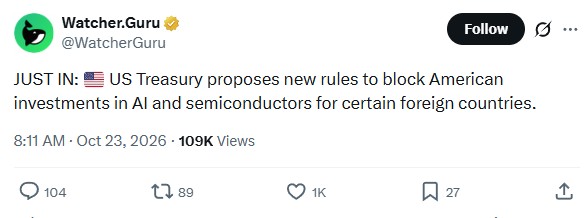
Treasury proposes blocks on US investments in AI and semiconductors in some foreign countries
The US Treasury has proposed new rules that would block investment in artificial intelligence projects (sorry, ‘Super Intelligence’ projects) and certain high risk semiconductors in some foreign countries.
The blocks have been mainly aimed at geopolitical rival China, but will now also encompass other adversaries including Russia, Iran, North Korea and Cuba. The rules would implement the COINS Act from December 2025 and expand the Outbound Investment Security Program that went into effect in January 2025.
They rules build on previous restrictions on selling high powered AI chips to China. The US is backing up its threats too, having announced the first $200,000 penalty this month to Amidi, LLC. Treasury for failing to report an investment by its Chinese subsidiary into embodied AI and robotics company Shanghai Qiongche Intelligent Technology (AKA Noematrix.)
US bans DeepSeek from civilian agency IT systems
The US Department of Homeland Security has ordered the removal of DeepSeek products from federal civilian agency IT systems.
The order, filed on Monday, also covers DeepSeek affiliates and third-party products and services developed using DeepSeek implementations while prohibiting affected agencies from making new purchases.
DHS warned that use of DeepSeek by government employees and contractors could expose sensitive information to China, potentially revealing details about US citizens and federal programs.
Solana’s Liu says Shanghai event postponed over registration surge
The Solana Accelerate event in Shanghai was postponed after pre-registration exceeded the event cap set by local authorities, according to Lily Liu, president of the Solana Foundation.
Event registration quadrupled overnight following publicity for the event, Liu wrote in a Friday X post, adding that organizers decided to postpone the event to “comply with local requirements.”
Earlier on Friday, X users claimed that the event was “abruptly suspended” as law enforcement officers were stationed at the venue.
Binance founder Changpeng Zhao posted he was impressed the Solana Foundation had been allowed to open a Shanghai office, noting than BNB Chain had been unable to do so.

JAPAN
Japan-Korea tourist spending becomes a test case for yen stablecoins
South Korea’s Shinhan Card has signed an agreement with Japan’s SBI VC Trade and SBI XDC Network APAC to test yen stablecoin payments for travelers and cross-border trade settlement.
Under the pact signed Tuesday, the companies will test stablecoin card payments, wallet-to-wallet payments and cross-border trade settlement. They will also assess anti-money-laundering and fraud-detection controls.
Shinhan Card is one of South Korea’s biggest credit card companies. SBI is a Japanese financial heavyweight that runs banks, brokerages, insurers and crypto exchanges.
Metaplanet to take 93.7% stake in Super League through 2,100 BTC deal
Shareholders of Super League, a Nasdaq-listed gaming and digital media company, approved a deal that would give Japanese Bitcoin treasury firm Metaplanet a 93.7% ownership stake, paving the way for its expansion into US capital markets through a publicly traded Bitcoin treasury company.
Metaplanet has also announced a planned repurchase of about $160 million of its own shares.
KOREA
South Korean finance officials met with crypto exchanges amid calls for tax delay
Finance officials reportedly met major crypto exchanges this week, days after a lawmaker introduced legislation that could push the start date of a new crypto tax back two years.
The meeting was a consultation on crypto taxation, with representatives from Upbit, Bithumb, Coinone, DigitalX and Gopax, along with executives of the Digital Asset Exchange Alliance, known as DAXA.
South Korean regulators have delayed the crypto tax three times, with the latest delay pushing the start date to 2027 amid political disagreement and industry pushback.

Seoul at night. Source: Pexels, gijecho
Injective, BDACS plan Korean won stablecoin settlement for tokenized assets
Blockchain network Injective has entered into a memorandum of understanding with South Korean digital asset custodian BDACS to bring a won-backed stablecoin to its tokenized asset markets, potentially allowing institutions to settle transactions without relying on US dollar stablecoins.
Kakao plans KRW stablecoin payments ecosystem
Kakao, KakaoBank and KakaoPay have formed a new stablecoin task force to build the infrastructure required for won stablecoin issuance, custody and payments. The aim is to start with shopping and gifting.
MALAYSIA
Malaysia central bank launches DLT platform for tokenized bonds
Malaysia’s central bank has launched a distributed ledger-based platform for issuing and holding tokenized bonds, connecting digital securities records with a payment system designed to operate around the clock.
Bank Negara Malaysia (BNM) said that its next-generation Scripless Securities Depository System (SSDS+) supports the issuance, depository and safekeeping of tokenized debt securities, including Islamic bonds known as sukuk.
THAILAND
Bitget plans Thai crypto exchange acquisition weeks after $388M hack
Crypto exchange Bitget has announced plans to acquire Thailand’s GMO-Z.com Cryptonomics, seeking to expand its Southeast Asia footprint weeks after a major hack impacting its hot and warm wallets.
The proposed transaction involves BTGT Management (Thailand), a company in which Bitget says it holds an interest, according to an announcement shared with Cointelegraph. The acquisition will allow Bitget to introduce its trading platform to Thai users.
Chinese suspect in $75M international crime network arrested in Bangkok
Thai police arrested a 37-year-old Chinese man wanted by authorities in China for alleged involvement in an international crime network and money laundering.
Investigators said the network handled more than 500 million yuan ($75 million) in transactions, Thai media Khaosod English reported in a post on X on Saturday.
Police alleged the suspect was involved in cryptocurrency and foreign-currency exchanges for criminal groups across more than 133 accounts. Investigators said he attempted to evade arrest by using forged documents to report his residence and changing vehicle registration plates before police found him in a luxury house in Bangkok.
VIETNAM
Da Nang crypto sandbox targets digital tourism
The fourth largest city in Vietnan, Da Nang, is using a controlled sandbox that enables businesses to employ crypto related applications in the tourism industry. Da Nang welcomed 15.9 million visitors in the first nine months of 2026.
Vietnam-EFTA agreement includes Crypto Valley links
Vietnam has signed a free-trade agreement with the European Free Trade Association countries of Switzerland, Iceland, Norway and Liechtenstein. Following a meeting with the Vietnamese PM, Swiss President Guy Parmelin proposed linking Switzerland’s Crypto Valley hub with Vietnam’s innovation ecosystem to further cooperation in blockchain, AI and quantum technology.
SINGAPORE
Singapore Gulf Bank offers retail USD-stablecoin conversion
Singapore Gulf Bank (which is actually licensed by Bahrain) announced that retail customers can convert between dollars for USDT or USDC via its mobile banking app.
Singapore-backed manager launches Swiss bitcoin ETF
The Singapore backed BIT Asset Management has launched Switzerland’s first Bitcoin ETF. Formerly known as Matrixport, it’s Zurich arm has been approved by the Swiss Financial Market Supervisory Authority to launch the country’s first spot Bitcoin ETF and Europe’s only spot Bitcoin ETF.
#DeepSeek #Ban #SwissAsia #Crypto #Ties #Deepen #Asia #Express
]]>ORLANDO, Fla. — The Orlando Magic are hoping to get in the win column when they take on the Minnesota Timberwolves in their second game at the Kia Center.
In order for them to reverse their result from opening night against the Atlanta Hawks, they will need to figure out how to improve their defense, which allowed way more points than anyone expected going into the night. For a team that prides itself on the defensive end of the floor, giving up 132 points isn’t very indicative of that identity.
Here’s a look at the two things the Magic must do to improve on defense.
Limiting Their Turnovers

The Magic committed 20 turnovers in their first game against the Hawks, and that ultimately was what cost them the win.
Orlando led 19-9 going into the fourth quarter, but their sloppiness in taking care of the basketball is ultimately what did them in.
“I think defensively from them that they were physical, picking up full [court], from the guards and stuff,” Carter said.
“So, I think for us bigs really anyone else, that would be a pressure release for them set some screens for them in the backcourt free them up a little bit. Just get us into our sets a little quicker. I think we had 20 turnovers, 19, something like that. Hard to win a game when you don’t win the possession battle. I think our defense was pretty good, you know, we turned them over, but again it was the fouls.”
No More Easy Fouls

Orlando did not do a good job defending without fouling. This was extremely apparent in the second quarter, when they committed nine fouls and sent the Hawks to the free-throw line to go 12 of 14 from the charity stripe. The second quarter is really when the game fell out of Orlando’s hands. The Hawks outscored the Magic 44-29 in those 12 minutes, and that ultimately cost them the game.
While Orlando came back in the third quarter, they did enough damage to allow Atlanta to stay at arm’s length in the fourth quarter and make a run by knocking down shots at the end of the game.
“I started reaching around a little too much. On myself, fouling a three-point shooter,” Carter said.
“Had some crucial calls down the stretch that we could have easily avoided by being in the stance and being ready. I think, clean up the whole boards. You know, understanding late in games that teams are going to crash, show us more opportunities. So, clean that up. I think get us guys a better chance, especially late in the game.
The good thing about where the Magic are at this point is that they feel as though they can improve from within. Orlando has a chance to clean up these mistakes, and if they do so, they should have a chance to beat the Wolves.
 Add us as a preferred source on Google
Follow
#Ways #Magic #Fix #Biggest #Weakness #Wolves
]]>HanuMan actor Teja Sajja is reportedly set to tie the knot with a woman based in the United States in December 2026. In a recent conversation, the actor confirmed his plans to get married and revealed that his soon-to-be wife has no connections to the film industry.
Teja Sajja to marry a US-based woman in December 2026?
In a conversation with Deccan Chronicle, Teja Sajja opened up about his fiancée and explained why he appreciates her life away from the limelight.
“She was raised in the USA and is totally unaware of the limelight and I liked that the most and wish to continue to keep it that way. Her family has no connections with films, they are into the tech industry, she works with her father,” the actor said.
Teja also revealed that the couple is planning an intimate wedding attended only by close family members and friends. Their engagement is expected to take place in November, followed by the wedding in December 2026.
Speaking about his preference for a private celebration, the actor said, “I have always kept my personal life totally private and would do the same with the wedding as well. It will be an intimate wedding with just family and close friends.”
The wedding is reportedly planned to take place in Rajasthan, with close family members and friends in attendance. Following the ceremony, Teja is expected to host a reception in Hyderabad, which may see several prominent actors and members of the Telugu film industry joining the celebrations.
Teja Sajja’s work front
Teja Sajja recently made his debut as a show host with The Traitors Telugu, which streams on Prime Video. The reality show brings together 20 contestants from different walks of life for a game centred on alliances, deception and betrayal.
Following the release of Mirai in 2025, the actor is set to headline Zombie Reddy NXT LVL, a sequel to his horror-comedy film Zombie Reddy. Directed by Suparn S. Varma, the upcoming film also features Kannada star Upendra and Shanaya Kapoor in key roles.
The first instalment, Zombie Reddy, was directed by Prasanth Varma, who later helmed the blockbuster HanuMan. The film also starred Anandhi, Daksha Nagarkar, Kireeti Damaraju, RJ Hemanth, Getup Srinu and Lahari Shari, among others.
Download Pinkvilla Buzz now with one click: Pinkvilla Buzz.
ALSO READ: Scene: Suriya starrer introduces Naslen as Eeswaran, a charming villain in action comedy flick
#HanuMan #actor #Teja #Sajja #married #based #woman #December #Heres
]]>
Digital Freedom Fund, the Super political action committee (PAC) launched by Gemini co-founders Cameron and Tyler Winklevoss in 2025, announced additional expenditures for US Senate races in the 2026 midterm elections, attempting to influence voters in Texas, Iowa and Ohio.
In a Tuesday filing with the US Federal Election Commission (FEC), the Digital Freedom Fund reported its first spending on ads to support Republican candidate Ken Paxton for one of Texas’ Senate seats. According to the PAC, it had spent more than $81,000 on direct mail media to support Paxton and oppose Democratic candidate James Talarico, with early voting having already begun in the state.
The Winklevoss-backed Super PAC, which reported raising about $34 million as of Sept. 30, did not limit its spending to Texas, reporting involvement in other key midterm election races using ads. Digital Freedom Fund reported additional expenditures in Ohio’s Senate race between Republican Jon Husted and Democrat Sherrod Brown, bringing the PAC’s total support for Husted to about $7 million.
The expenditures into candidates that could support crypto policies and laws come as event contracts on prediction market platforms Kalshi and Polymarket heavily favored Democrats retaking majority control of the House of Representatives and Senate in 2027. Whichever party holds a majority in each chamber would have a significant impact on passing legislation like the Digital Asset Market Clarity Act, a market structure bill that failed to pass a procedure vote in the Senate last month.
Related: PACs laud Texas primary wins, look to back more pro-crypto candidates
Paxton already benefitted from $500,000 in supportive ads ahead of the May Republican primary, in which he defeated incumbent Senator John Cornyn. The ads, funded by the Anchorage Digital- and Cantor Fitzgerald-backed Fellowship PAC, went through the Nxum Group, a marketing company co-founded by Bo Hines, a former crypto adviser to US President Donald Trump who became CEO of Tether US after leaving the White House.
According to an October Wall Street Journal report, Nxum profited from Hines’ role in government, as he helped push a stablecoin bill while keeping a stake in the company. Nxum reportedly received $6.3 million as part of a deal with stablecoin issuer Tether, the first payment of which went through while Hines was still at the White House.
Early voting began in Texas on Oct. 19, with Election Day coming up on Nov. 3. Cointelegraph reached out to the Talarico and Paxton campaign teams for comment but did not receive an immediate response.
Spending escalates in Ohio Senate race with Fairshake PAC
Fairshake, a separate PAC aligned with the interests of the crypto industry and largely funded by Ripple Labs, Coinbase and Andreessen Horowitz, reported more than $13 million combined in spending on a direct mail campaign to support what it considered to be “pro-crypto” candidates this week. The PAC’s latest FEC filing showed more than $4 million to oppose Independent candidate Dan Osborn in Nebraska’s Senate race and an additional $9 million to support Husted over Brown.
While the battle for Ohio’s Senate between Brown and Husted has seen significant spending by PACs — Fairshake had invested about $56 million as of Wednesday and Digital Freedom Fund reported $7 million in total media purchases — Texas races have also spawned interest from Republican donors looking to prevent the state potentially losing Senate and gubernatorial seats to Democrats for the first time in more than 30 years.
FEC filings showed that Elon Musk, the world’s richest person and founder of SpaceX, had poured more than $150 million into the Senate Leadership Fund. The PAC, supporting Republican Senate candidates, sent the same amount Musk donated to the Texas PAC, which has supported Paxton through ads.
Magazine: 5 alternatives to Ledger to store your Bitcoin
#WinklevossBacked #PAC #Backs #Paxton #Texas #Senate #Race
]]>In the days leading up to Illinois’ Nov. 2 regular-season opener at Champaign’s State Farm Center, Illinois on SI will share a scouting report for each Illini player on the team’s official 2026-27 roster. Today, in the third of 15, we shine a light on forward Jake Davis. Find our scouting reports of other Illinois players as they’re added below.
Jake Davis | Forward | Senior | No. 15
Hometown: McCordsville, Indiana
High School: Cathedral
Transfer School: Mercer
Height: 6-foot-6
Weight: 210 pounds
Jake Davis statistics and 2025-26 season
After playing a limited role in his first season at Illinois, Davis took a significant step forward in 2025-26. As a junior, he appeared in all 37 games, starting in 22 – including the final 19 games of the season. Davis averaged 5.4 points and 2.2 rebounds while shooting an impressive 40.6 percent from three-point range. He knocked down 54 three-pointers, more than doubling his total from the previous season, and played an important role in Illinois’ run to the Final Four.
|
Season |
School |
Minutes |
Points |
FG% |
FT% |
3s |
3FG% |
Rebounds |
Assists |
Blocks |
Steals |
|---|---|---|---|---|---|---|---|---|---|---|---|
|
2023-24 |
Mercer |
28.6 |
9.0 |
41.9 |
84.8 |
60 |
38.7 |
4.5 |
1.1 |
0.4 |
0.7 |
|
2024-25 |
Illinois |
9.4 |
3.0 |
41.2 |
50.0 |
22 |
34.4 |
1.4 |
0.3 |
0.2 |
0.0 |
|
2025-26 |
Illinois |
19.6 |
5.4 |
42.9 |
75.0 |
54 |
40.6 |
2.2 |
0.7 |
0.2 |
0.3 |
Scouting Jake Davis
Davis is the best pure shooter on Illinois’ roster (and likely among the best in the country) and has established himself as a key floor spacer in the Illini offense. At 6-foot-6, he has solid size for a wing and a quick release that allows him to get shots off even with defenders closing out. He is especially effective in catch-and-shoot situations, particularly from the corners, where he can make defenses pay for leaving him open. Although Davis isn’t much of a shot creator, he understands his role and rarely forces anything offensively, making him an extremely efficient player.
Great hustle play by Ethan Brown, then Quentin Coleman hits Jake Davis for his patented corner three. pic.twitter.com/0EFBljOyUh
— Glenn Kinley (@glenn_kinley) October 17, 2026
Defensively, Davis made noticeable improvements last season. Although not the quickest or most athletic wing, he makes up for some of those limitations with his effort, positioning and basketball IQ. He is a fundamentally sound player who rarely makes mistakes and is willing to do the dirty work on both ends of the floor. His ability to contribute without needing the ball in his hands makes him an extremely valuable role player for the Illini.
Jake Davis’ experience
Davis began his college career at Mercer, averaging 9.0 points and 4.5 rebounds per game as a freshman while shooting 38.7 percent from beyond the arc. Davis then entered the transfer portal and committed to Illinois, where he is now entering his third season with the Illini and Brad Underwood.
Jake Davis highlights
What they’re saying about Jake Davis
Illinois coach Brad Underwood on Davis at Big Ten media day in October:
“He’s a championship-level role player. He’s invaluable to our team. He’s an incredible leader. He’s capable of scoring 20 [points] in a half because he does everything we ask him to do – but he doesn’t need the ball. And yet he creates great space with his shooting.”
What we expect from Jake Davis in 2027-27
Davis enters his senior season as one of the most experienced players on the Illinois roster and should again play an important role for Underwood. After starting the final 19 games last season, Davis has proven he is capable of handling significant minutes against some of the best competition in the country. With Andrej Stojakovic presumably returning to the starting lineup and several talented newcomers joining the roster, Davis may find himself coming off the bench more often, but he will still be a regular part of the rotation.
Jake Davis who is hitting at a 42% clip from downtown with a MASSIVE Trey. Absolutely massive pic.twitter.com/uvLtyy1Y1R
— Dariush Takhtehchian, M.D (@takhtehchianmd) January 25, 2026
Offensively, Davis doesn’t need to take a major leap to be effective. His ability to knock down open three-pointers and space the floor will be extremely valuable for an Illinois team loaded with offensive talent. Even if he doesn’t put up huge scoring numbers, Davis has shown that he can make a significant impact without dominating the ball. Expect him to be one of Illinois’ most dependable role players as the Illini look to build on last season’s Final Four appearance.
Add us as a preferred source on GoogleFollow
#Illinois #Basketball #Scouting #Report #Jake #Davis
The Paradise, starring Nani in the lead role, premiered on Netflix on October 22, 2026. Following its digital release, reports suggest that the action thriller has been shortened by approximately 24 minutes compared to its original theatrical version.
The Paradise: Nani starrer trimmed by 24 minutes from action thriller?
According to a report by The Indian Express, the revised OTT version of The Paradise runs for approximately 2 hours and 30 minutes, making it nearly 24 minutes shorter than the original theatrical cut, which had a runtime of 2 hours and 54 minutes.
One of the most notable reported changes is the removal of the Dhumavathi fight sequence, which became a major talking point following the film’s theatrical release. According to reports, the sequence has been omitted entirely from the streaming version.
The shorter cut reportedly removes several other scenes featuring graphic violence, along with sequences considered unnecessary to the central narrative. These edits appear to streamline the film for its digital release while retaining the core storyline.
Additionally, some visual effects (VFX) sequences have reportedly been refined in the OTT version. While the reported changes have shortened the film considerably, the overall narrative remains intact.
More about The Paradise
Set in 1980s Secunderabad, The Paradise follows the struggles of Savaari, a marginalized nomadic tribe living in a slum and deprived of basic rights, identity, and recognition. The community lives under the control of feudal landlord Shikanja Malik, with Sammakka being one of the few people willing to challenge his authority.
When Sammakka’s son, Jadal, returns home, he draws inspiration from his mother’s courage and takes up the fight for his community’s recognition and dignity. His demand threatens the ambitions of Shikanja’s son, Vikram, triggering a fierce conflict involving rival factions, manipulation, and powerful forces determined to stop the movement.
As tensions escalate and the community’s future hangs in the balance, Jadal leads a determined fight against the Malik family. The struggle takes a heavy emotional toll, but the Savaari eventually gain official recognition as citizens. Despite a heartbreaking personal loss, Jadal succeeds in securing the dignity and recognition his people have long sought, bringing the story to a bittersweet yet hopeful conclusion.
Apart from Nani, the film stars Mohan Babu, Kayadu Lohar, Sonali Kulkarni, Raghav Juyal, Sampoornesh Babu, Easwari Rao, and more in key roles.
Looking ahead, the Natural Star will appear in a lead role in the movie Bloody Romeo.
Download Pinkvilla Buzz now with one click: Pinkvilla Buzz.
ALSO READ: HanuMan actor Teja Sajja to get married to a US based woman in December 2026? Here’s what we know
#Paradise #Nani #starrer #trim #minutes #movie #OTT #release #Find
]]>
Bitcoin’s network hashrate has climbed to a seven-month high despite major publicly traded miners shifting capacity toward artificial intelligence, suggesting other operators are replacing lost computing power and intensifying competition among remaining network miners.
According to BlocksBridge Consulting’s latest Miner Weekly newsletter, Bitcoin’s seven-day average hashrate has recovered above 1 zettahash per second (ZH/s), equivalent to 1,000 exahashes per second (EH/s), its highest level since March 3.
Hashrate measures the computing power securing the Bitcoin network. The recovery suggests that miners still operating on the network are seeing little relief from competition, despite the industry’s ongoing transition to AI workloads.
Bitcoin’s mining difficulty increased 5.92% on Oct. 16, with BlocksBridge projecting another 5.16% increase at the next adjustment. If the estimate holds, difficulty will have risen roughly 11.4% across two consecutive adjustments.
“That’s hardly the breathing room remaining miners might have expected from the AI migration,” BlocksBridge wrote, referring to the growing competition facing operators that have continued mining Bitcoin.
The shift toward AI has already taken substantial mining capacity offline. BlocksBridge previously reported a 23% decline in publicly traded miners’ realized hashrate, alongside a 52% quarterly increase in their reported AI and high-performance computing revenue. It estimated that the displaced capacity represented roughly $1.5 billion in mining hardware.
Related: Crypto Biz: AI took a back seat when Bitcoin started climbing
Smaller miners may be picking up the slack
Some of the lost capacity may be returning to the network through smaller and mid-sized miners buying equipment from larger operators. BlocksBridge pointed to Sazmining, which advertises secondhand Antminer S21 XP machines that buyers can deploy through hosting facilities in Paraguay and Texas.
For miners with access to cheaper electricity, buying used machines could be more economical than investing in new equipment. It also means hardware displaced by AI conversions could continue mining Bitcoin elsewhere.
However, it’s unclear how much of the equipment being sold actually comes from publicly traded miners, or how much has returned to the network.
The hashrate recovery comes as some industry observers view rising computing power as an “indirect bullish signal” for Bitcoin, reflecting continued institutional investment in publicly traded mining companies.
CryptoQuant founder and CEO Ki Young Ju recently made that argument on X, writing that “higher hashrate means stronger security and better fundamentals as a store of value.
Related: Bitcoin miners face widening AI financing costs as lenders scrutinize deals
#Bitcoin #Mining #Difficulty #Rises #Hashrate #Recovers
]]>SAN ANTONIO — The Spurs started their season off on the wrong foot, but their starting five wasn’t the primary culprit.
The three-guard lineup has generated more headlines and questions than anything heading into opening night against the Thunder, and Victor Wembanyama put up the worst shooting performance of his NBA career in that game. It makes sense why people want to blame those highly-visible things for the disappointing result, but that impulsive reaction ignores the reality of what happened on the court.
The Big Four Dominated
The four-man unit of Fox, Harper, Castle and Wemby logged just over 12 minutes together, though it probably would have been about 15 if the game had been close in the final minutes. The guard trio only played alongside Wembanyama, and Devin Vassell played nine minutes at the four with most of the rest going to Julian Champagnie. They played a four-minute stint to start the game, then six to start the second half, then got together again in the last few minutes of regulation.
The Spurs won these 12 minutes by 12 points in a 12-point loss, meaning they did fantastic together and the rest of the game OKC outscored San Antonio by 24.
Many feared that this grouping would struggle with shooting and spacing, but for now those fears appear to be unfounded. The Spurs shot 13-24 from the floor and 5-10 from deep. They swarmed on defense, holding the Thunder to 8-24 from the field and 2-10 from deep. They did most of their damage to start the second half, finding a rhythm and scorching OKC on a 23-11 run.
pass, pass, threeeee!
@NBAonNBC pic.twitter.com/OWBdAZEjRj
— San Antonio Spurs (@spurs) October 21, 2026

“It was defense feeding our offense and our talented guys, our guards doing what they do,” Wembanyama said. “It felt more natural in this moment. Felt like offense was feeding our defense and vice versa.”
This group did a decent job of limiting the transcendent talent of Shai Gilgeous-Alexander, who shot 3-9 from the floor for nine points against the Big Four. All three guards can share and execute the responsibility of guarding him closely, and all of them can play tighter to his body knowing that if he does blow by, he’ll have to contend with Wemby at the rim.
The locked-in defense led to transition opportunities for a group of guys that no defender wants to see running downhill.
“We all just have to understand that we’re at our best when we’re on attack mode, and in order for us to do that, we all have to play with each other,” Harper said. “We have to run the floor. Most importantly, we have to get stops. But it’s the first time in a real game with the lineup, and I can tell you that’s gonna be better days to come with that lineup.”
The problem wasn’t the three guards together; the problem was the other three quarters of the game where the Spurs got crushed. It’s quite possible that starting all four makes it more difficult to stagger talent across the rest of the rotation. They played 21 minutes with two of the three guards on the court, and almost 14 minutes with just one. The guard trio was the most used and most effective combination, a trend that continues from the preseason.
Castle Adapting to Changing Role
The Big Four worked in part because Stephon Castle went bombs away from deep, finishing the game 5-12 from long range. He made 4-7 while sharing the floor with the other two guards and Wembanyama. He’ll need to be an efficient catch-and-shoot threat from downtown to space the floor effectively and allow Fox, Harper, and Wemby to attack the rim.
It’s especially important if teams elect to guard Castle with a big man and sag off of him. We know he’s capable of playing with the ball in his hands, but he’s clearly put a lot of work into playing effectively without it.
“Moving off the ball a lot more,” Castle said when asked about his focus in that area. “Just constantly staying ready to ready to shoot, not letting the ball surprise me.”
Castle can also be useful off the ball by setting screens for Fox, Harper, and Wembanyama. He’s a big, strong guard, and when all of these guys are on the floor together defenses may try to hide their worst defender on him. Let him set a good screen and force a switch, let him pop for a three or roll to the basket with the bounce of a Dunk Contest participant and the vision of a point guard.
What Wemby Did Well
The Spurs played much better with Wembanyama on the court than when he was off, an impactful force despite the worst shooting game of his NBA career. He was a -2 across 34 minutes, logging 12 points, 13 rebounds and six blocks.
While this game drew some complaints from the viewing public about players drawing touch shooting fouls on soft contact, those complaints were not directed at Mr. Wembanyama who earned his free throws in blood. On four occasions he made a move to the basket that surely would have ended in an extraterrestrial dunk if not for a hard foul by OKC.
Wembanyama fought hard on both ends to use his gravity to open up opportunities for his teammates, and his antigravity on defense probably deterred twice as many shots as he prevented.
NOOOOPE…AGAIN!
— San Antonio Spurs (@spurs) October 21, 2026

This all worked best with the starters, and the numbers bear that out. If Wembanyama was -2 for the game and +12 with the guard trio, that means he was -14 with the other guard arrangements.
The stat line obviously shows how much Wembanyama struggled in this game, but it also shows how absurdly high his floor is as a player even if nothing is going right for him.
The most impressive thing about Wembanyama’s performance is that he never gave up despite his own struggles and the team’s large deficit. He flew around the court and brought energy to his team when they needed it most. If he hit a few more shots, it would’ve been a totally different ballgame.
Mauled in Non-Wemby Minutes
The Spurs lost by 12 in a game where they only lost Wembanyama’s 34 minutes by a single bucket, so the other 10 points of the scoring margin slipped away with him off the floor. Oklahoma shot 59% from the floor and 7-11 from deep with Wemby riding the pine, while San Antonio’s offense sputtered.
The non-Wemby minutes became a serious concern in the postseason, and the Thunder continue to do a good job of attacking backup center Luke Kornet’s weak points.
Kornet is a non-shooter so defenses drop on his pick and rolls, limiting driving and rolling opportunities. With the lane clogged, drivers fail to create advantages and either pass out or settle for jumpers. The best answer to this is setting the screen higher and spreading the floor as much as possible.
On this play Kornet set the pick high and rolled fast as Keldon’s drive engaged the drop defender. Kornet snuck behind the defense for lob.
KJ
LUKE
— San Antonio Spurs (@spurs) October 21, 2026
In order to capitalize on Kornet’s vertical spacing, he needs to have a lane to the basket and some space between himself and the ball handler. This forces that defensive center to choose between the lob or the floater.
Kornet himself defends pick and rolls mainly in a drop, which presents the same options from the other side of the play. On multiple occasions the Thunder were able to generate wide-open looks from deep for shooters like Jared McCain with handoffs and other plays that screened off the guard defender and took advantage of the space Kornet has to give.
OKC is uniquely equipped to hammer this advantage, and Kornet isn’t the only reason the Spurs struggle with their MVP candidate on the bench. Still, if Kornet continues to struggle San Antonio might be inclined to see how ready rookie Tarris Reed Jr. is for some NBA minutes.
Add us as a preferred source on GoogleFollow
#Spurs #ThreeGuard #Lineup #Dominated #Thunder
A delayed update for Pinkvilla Predicts this week. There are no new entries, but we have a trailer update for Ramayana: Part One and the final update for Udta Teer.
Other Updates
Ramayana: Part One released its trailer last week, and the response has been extremely positive. Confidence in the film was already high, but some of the assets released earlier had attracted criticism, mostly nonsense about VFX and all that, but this trailer has silenced all of that.
The advance bookings opened in India two days ago, and they are off to a superb start. Read more about that here. The marketing campaign is also gathering momentum, with multiple events taking place over the last couple of days.
The only caveat at this point is the pre-Diwali release window. It remains to be seen how much of an impact it will have, as it has been a while since a film of this scale arrived during this period. Nevertheless, with the trailer boosting confidence and the marketing campaign beginning to build momentum, the pinpoint forecast has been raised closer to the high end of the projected range.
Udta Teer has done little to move the needle on its buzz heading into the final week before release. Advances are in a similar range to Pati Patni Aur Woh Do, which is broadly in line with expectations. The forecast remains largely unchanged, but the high end of the projected range now looks unlikely. Accordingly, the final forecast has been revised downward to Rs. 2.5-4 crore nett from Rs. 3-5 crore nett.
Pinkvilla Predicts First Day Box Office Forecast is as follows:
| Release Date |
Title | Low-End Forecast |
High-End Forecast |
Pinpoint Forecast |
|---|---|---|---|---|
| 23/10/2026 | Udta Teer | Rs. 2.50 cr. | Rs. 4.50 cr. | Rs. 3.00 cr. |
| 23/10/2026 | Pehla Pyaar Doosri Baar | Rs. 0.25 cr. | Rs. 1.00 cr. | Rs. 0.50 cr. |
| 05/11/2026 | Ramayana: Part One (Hindi) | Rs. 68.00 cr. | Rs. 78.00 cr. | Rs. 75.00 cr. |
NOTE: The films featured in Pinkvilla Predicts are not the only releases scheduled over the coming weeks. The tracking generally focuses on titles with notable cast value, industry visibility, or measurable audience awareness before release.
The forecast/predictions are for the organic box office collections. It’s impossible to predict the feeding, aka inorganic box office numbers.
DISCLAIMER: The box office figures, opening-day forecasts, and lifetime collection projections mentioned in this article are subjective trade estimates compiled from various commercial parameters, advance trends, and market sentiment. These are purely analytical tracking figures and do not constitute actual, finalised collections or certified accounting statements. Pinkvilla does not make any representation or warranty, express or implied, regarding the pinpoint accuracy or completeness of these projections. No statement in this article is intended to defame, harm, or malign any individual, production house, artist, or commercial entity involved in the making of the film.
Download Pinkvilla Buzz now with one click: Pinkvilla Buzz
ALSO READ: Pinkvilla Predicts: First day box office forecast of Ramayana: Part One, final update for Jailer 2, Prahaar and Nayi Navelli
#Pinkvilla #Predicts #Trailer #boosts #confidence #Ramayana #Part #final #update #Udta #Teer
]]>On October 23rd-24th, Venus retrograde is conjunct the Sun at 0° Scorpio, and a new Venus cycle begins.
This is the midpoint of the Venus retrograde and the moment when Venus crosses over from evening star to morning star.
This is the last Venus cycle to start in Scorpio for a very long time. Venus’ dance in the sky follows an 8-year rhythm – she returns to retrograde in the same sign every 8 years, for about 100 years.
Venus began this Scorpio story in 1930, and since then, every 8 years, she has come back to meet the Sun in Scorpio – each time a couple of degrees earlier in the sign.
This Venus cycle that starts on October 23-24, 2026 is the last one. At 0° Scorpio.

A story that has been weaving for 100 years comes to an end.
Scorpio is a tough school for Venus’ heart. In Scorpio, Venus learned how to hold still, how to go deep. She learned about all the Scorpio virtues – trust, depth, and loyalty…
…but the trust, the depth, the loyalty were not given. They were earned.
Trust was earned through fear.
Depth was carved by intense experiences of love, but also loss.
Loyalty was tested through betrayal.
Because how can we understand what these things truly mean if we don’t go to the source? If we don’t explore the full spectrum of experience?
Over the 100 years, our great-grandmothers, our grandmothers, our mothers – and now us – have been taking Scorpio’s medicine.
Perhaps it started with women losing their men and sons to war – and the lesson was that loss was the price of love. So the body made sure the hurt was remembered.
Perhaps it started with hardship, when resources were scarce, so you had to get strong, hold on to what you had, or sacrifice what you wanted for security.
Perhaps it started with abuse, and the memory remained frozen over years and decades, passed on in silences and warnings so that the children would remember and know how to protect themselves.
Your fear is not (only) your fear – it’s your parents’, grandparents’, and great-grandparents’ fear.
Your unworthiness is not (only) your unworthiness – it is a deep, unhealed longing for security, devotion, and the certainty that you matter enough for someone to stay.
Your grief is not (only) your grief – it’s your parents’, grandparents’, and great-grandparents’, from a time when it was safer to hold on and survive than to feel.
Now you’ve done the work. All these Scorpio lessons have been distilled, Venus star point after Venus star point, until the very essence is all that’s left.
The journey in the underworld was long and dark – there was no compass, no light to guide us, just more and more digging, more and more peeling back the layers, more and more coming face to face with what we had buried.
And here we are – with Venus cazimi at 0° Scorpio, the very last Scorpio Venus star point.
All this carrying ends now. It ends with you.
But the slate won’t be wiped clean. We won’t just leave it all behind and start anew. That’s not the point.
All that 100-year journey through the underworld hasn’t been for nothing. We didn’t do all this just as a “test” or some sort of wicked joke the universe played on us.
Just like the greatest riches lie buried deep in the earth, there are things we have discovered in the depths that we can now bring back with us: the strength of loyalty, the courage it takes to trust, the depth of a connection that can hold the truth.
Your mother, your grandmother, and your great-grandmother have all carried a piece of this story so you can get there – to the very essence of it…
…so you can find the diamond that they didn’t live to see. The road was paved by them, so you can reach this point and choose what happens next.
And now, with this alchemized essence of Scorpio love, you can bring the trust, the vulnerability, the loyalty, the depth of connection into the airy light of Libra.
8 years from now, a new 100-year Libra cycle will start, and the Scorpio treasures will find expression in clear communication, equal relationships, in cardinal agency and the recognition that we are the heroes and heroines of our own lives.
As we stand at the threshold of degree zero, take Scorpio’s gift with you.
It starts with you.
Subscribe To Future Updates
If you want to keep up with the future transits, make sure you subscribe to Astro Butterfly’s weekly newsletter.
Join 49.000+ Astro Butterflies around the world!
#Venus #Cazimi #Scorpio #Ends