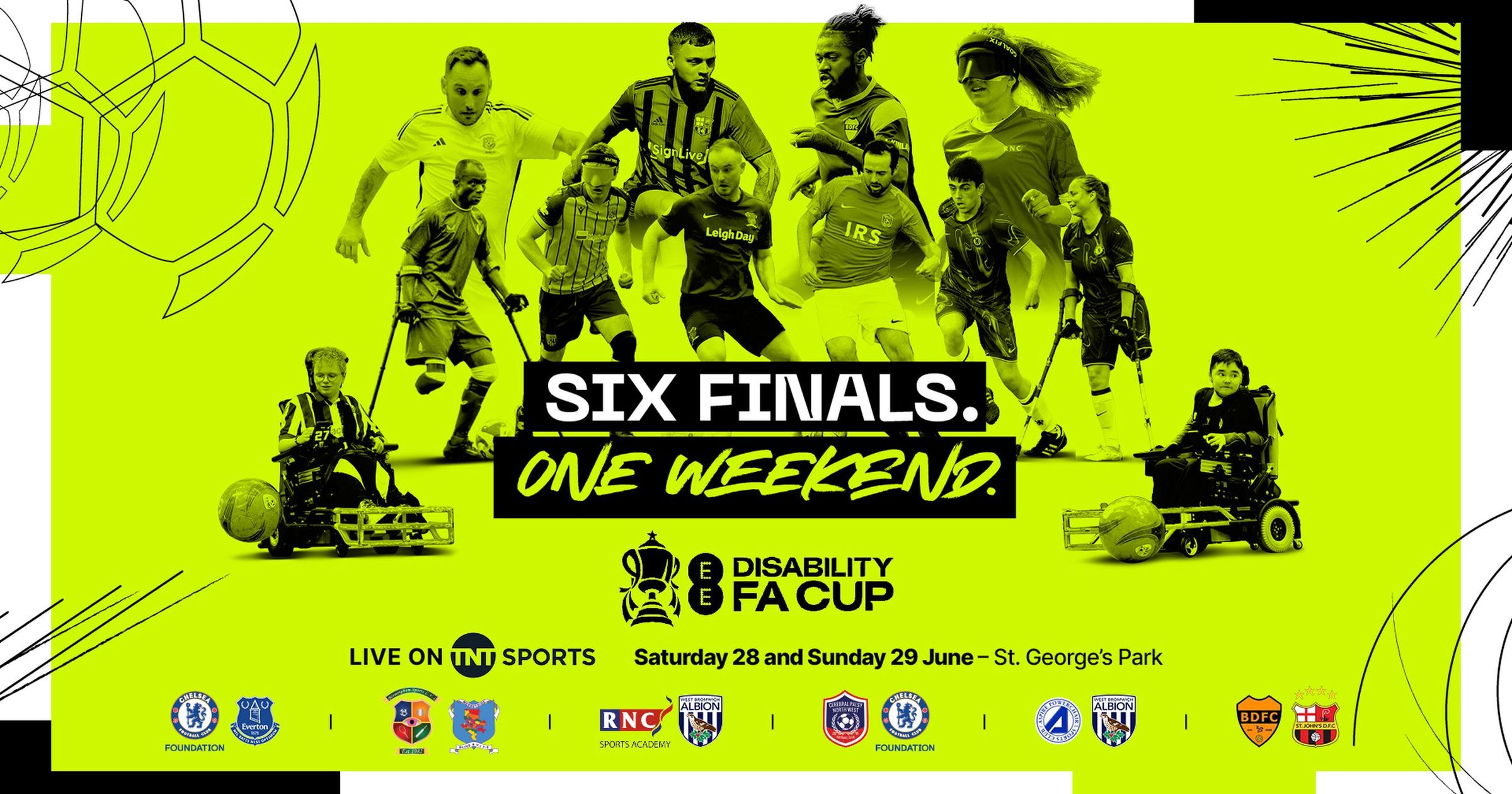
The EE Disability FA Cup ensures that players in impairment-specific football have a national FA competition to call their own with a total of six formats of the game competing: Amputee, Blind, Cerebral Palsy, Deaf, Partially Sighted and Powerchair.
Fans will have the chance to visit St George’s Park, which will be open for all to attend the finals and cheer on the teams from the stands.
For fans able to attend, the Experience Area will return for 2025; a dedicated space for equipment and adaptions to simulate some of the formats of disability football showcased throughout the finals weekend.
Read on for everything you need to know about the EE Disability FA Cup, including the rules and regulations of all six formats, the start times of the finals, how to watch on TNT Sports, and how you can get involved with Disability Football.
EE Disability FA Cup schedule
| Amputee Cup Final in partnership with England Amputee Football Association | ||
| 10:00 | Chelsea FC Foundation vs Everton in the Community | Indoor 3G |
| Partially Sighted Cup Final in partnership with the National Partially Sighted Football League | ||
| 12:30 | Birmingham Futsal vs Merseyside Blind & V.I FC | Futsal Hall |
| Blind Cup Final in partnership with the National Blind Football League | ||
| 3:10 | Royal National College for the Blind vs West Bromwich Albion Blind FC | Blind Pitch |
| Cerebral Palsy Cup Final in partnership with CP Sport | ||
| 10:15 | Cerebral Palsy North West FC vs Chelsea FC Foundation | Indoor 3G |
| Powerchair Cup Final in partnership with the Wheelchair Football Association | ||
| 12:20 | Aspire PFC vs West Bromwich Albion PFC | Futsal Hall |
| Deaf Cup Final in partnership with England Deaf Football | ||
| 2:20 | Barnet Deaf FC vs St. John’s Deaf FC | Outdoor Grass Pitch |
Saturday’s Blind Final will see a rematch of last year’s final, with Royal National College for the Blind and West Bromwich Albion FC competing once again, with the latter looking to make it two wins in a row.
Birmingham Futsal return to the Partially Sighted Final after narrowly losing in last year’s final. Their 2025 opponents will be Merseyside Blind & V.I FC.
This year’s Amputee Final will see 2024 runners-up Everton in the Community face Chelsea FC Foundation.
On Sunday, the Powerchair Final will see last year’s champions West Bromwich Albion PFC take on four-time winners, Aspire PFC.
Chelsea FC Foundation will be hoping to go one better than last year, with a match against Cerebral Palsy North West FC set for 2025’s Cerebral Palsy Final, and completing the weekend will be an all-North London affair as Barnet Deaf FC play St. John’s Deaf FC in the Deaf Final.
How to watch EE Disability FA Cup
TNT Sports will show every match from the EE Disability FA Cup exclusively live on TNT Sports 1 and TNT Sports 5.
TNT Sports 1 will feature live subtitles and Sign Language interpretation, while a simulcast on TNT Sports 5 will provide alternative audio-described match commentary.
TNT Sports is available across all major TV platforms, offering a line-up of up to four TV channels (TNT Sports 1, TNT Sports 2, TNT Sports 3, TNT Sports 4), and up to six digital or red-button channels (TNT Sports 5 to 10), and TNT Sports Ultimate plus TNT Sports Box Office HD.
Disability Football rules and regulations
Amputee football is for any player with an amputation or limb deficiency. In England, amputee football is not considered suitable for grass pitches and therefore takes place on 3G artificial turf pitches.
- There are seven players in each team, with a maximum squad size of 10.
- A match consists of two halves of 25 minutes.
- The pitch is 60m x 40m and smaller goalposts are used.
- Internationally, outfield players play without prostheses on aluminium wrist crutches, however the use of prostheses is permitted domestically at grassroots level.
- Two halves of 25 minutes in duration.
- No offside.
- The goalkeeper is not allowed out of the penalty area.
- Players are not allowed to strike the ball or any other player with their crutches. An infringement would result in a ‘handball’ decision being made against the player with the opposition receiving a direct free kick.
- Slide tackles are not allowed.
- Players kick the ball into play instead of a traditional throw in.
- Outfield players are not allowed to touch the ball with their residual limb – free kick awarded if they do.
- The goalkeeper is not allowed to save the ball with their residual limb – a penalty is awarded if this rule is broken.
Partially sighted football
Partially sighted football is played by individuals with a visual impairment, but it shouldn’t be confused with blind football. Players who play partially sighted football will have some level of sight whilst blind footballers may have a small amount of light perception at best, however goalkeepers can be fully or partially sighted.
- There are five players in each team, with a maximum squad size of 10.
- A match consists of two halves of 20 minutes, but the clock stops when the ball is out of play.
- A standard futsal pitch is used, however the playing areas should be free of other markings.
- Light must be of an equal intensity on all parts of the field of play and during the entire match – variations in light intensity are prohibited in all circumstances.
- The ball should be a colour that clearly contrasts from the pitch and lines.
- The goalkeeper is not allowed to leave the penalty area if he/she is fully sighted.
- Internationally, a team shall never have more than two B3 players on the pitch when they play with a fully sighted goalkeeper.
- Goalkeepers can distribute the ball anywhere on the pitch, but if aiming for a teammate in the opposition half, the ball must bounce before the halfway line.
Outfield players must be registered as B1 (completely blind) although the goalkeepers can be either sighted or partially sighted.
To facilitate the running of the game, there is boarding placed along the length of pitch to keep the ball in play and provide a reference point for the players when they are on the pitch.
All outfield players must wear eye patching and an eye mask to ensure a level playing field, as some players may have a little light or shadow perception.
The ball is also adapted with panels stitched in that have metal shards that create a noise as it rolls across the playing surface for the players to be able to hear and locate it. Spectators must remain silent in order to allow the players to hear the ball clearly and the playing area will often be uncovered to allow for optimum acoustics.
- There are five players in each team, with a maximum squad size of 10.
- A match consists of two halves of 15 minutes, but the clock stops when the ball is out of play. (There has been a rule change to the timings changing from 20 minutes to 15-minute halves.
- The pitch is 40m x 20m and has kickboards along the touchline to keep the ball in play and help the players locate themselves.
- Goalkeepers are sighted but must stay within a small, restricted area.
- Players must shout ‘voy’ before engaging with an opponent.
- Spectators must remain silent to allow the players to hear the rattling ball and echoes from the kickboards, as well as verbal instructions from coaches and sighted guides.
- Teams are permitted to commit five fouls per half, but then an eight-metre penalty is awarded for each one thereafter.
Cerebral Palsy football is for ambulant players (able to move unaided) with cerebral palsy and other neurological disorders that have resulted in a physical impairment, such as stroke or traumatic brain injury.
- There are seven players in each team, with a maximum squad size of 14.
- A match consists of two halves of 30 minutes.
- The pitch used is 70m x 50m and smaller 5m x 2m goal posts are used.
- No offside rule.
- Roll-ins are permitted as well as standard throw-ins, to assist players with hemiplegia (paralysis of one side of the body).
Powerchair football is for anyone who uses a powered wheelchair or those who have limited movement in a manual wheelchair. Its unique nature allows players of all ages and genders to compete together on the same team, largely due to any physical contact being limited to chair-to-chair.
The game is played on an indoor pitch roughly the same size as a basketball court. There are strict rules relating to the chairs and speed testing takes place before and after each game.
- There are four players in each team, with a maximum squad size of eight.
- A match consists of two halves of 20 minutes.
- Played indoors on a 30m x 18m court.
- The goalposts are unique as two upright posts are placed 6m apart, but there is no crossbar.
- A larger 33cm-diameter ball is used.
- Only two defenders are allowed in the penalty area at once, no restrictions for the attackers.
- Two on one rule replaces offside – only one player and an opponent are allowed within 3m of the ball when in play. The only exception is for a goalkeeper when in their own penalty area. An indirect free kick is awarded for infringements.
- Push ins replace throw ins.
- Tackling is allowed if it is playing-attachment-to-playing-attachment – contact with any other part of the chair or ‘ramming’ is not permitted.
To be eligible to play within deaf specific competitions, players must have a hearing loss of 55 decibels (dB) per tone average in their better ear.
- Referees are expected to raise their flag to accompany their whistle to give a visual cue to players that the game has been stopped.
How to play Disability Football
#Disability #Cup #Rules #formats #start #times #watch #finals #TNT #Sports #discovery