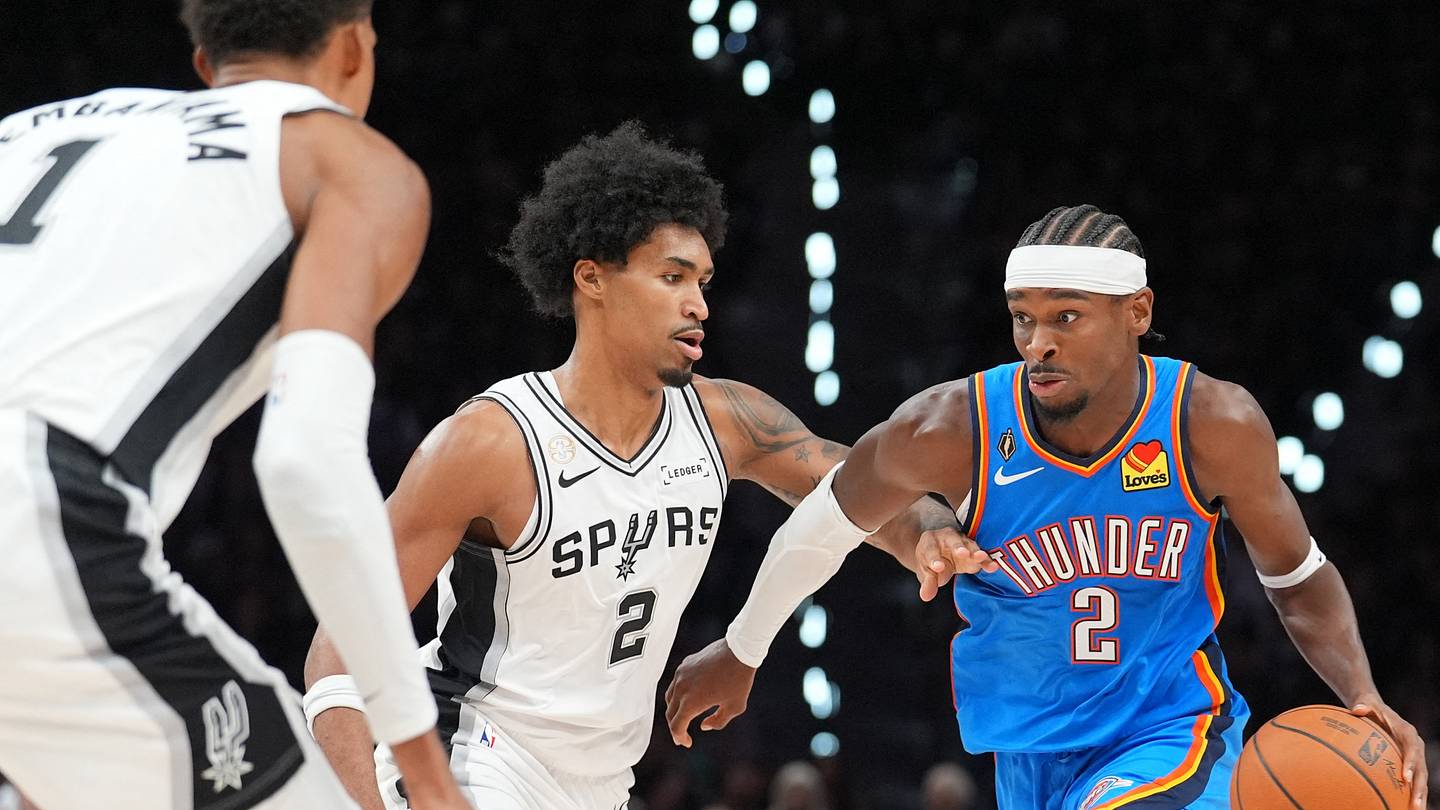
SAN ANTONIO — The Spurs started their season off on the wrong foot, but their starting five wasn’t the primary culprit.
The three-guard lineup has generated more headlines and questions than anything heading into opening night against the Thunder, and Victor Wembanyama put up the worst shooting performance of his NBA career in that game. It makes sense why people want to blame those highly-visible things for the disappointing result, but that impulsive reaction ignores the reality of what happened on the court.
The Big Four Dominated
The four-man unit of Fox, Harper, Castle and Wemby logged just over 12 minutes together, though it probably would have been about 15 if the game had been close in the final minutes. The guard trio only played alongside Wembanyama, and Devin Vassell played nine minutes at the four with most of the rest going to Julian Champagnie. They played a four-minute stint to start the game, then six to start the second half, then got together again in the last few minutes of regulation.
The Spurs won these 12 minutes by 12 points in a 12-point loss, meaning they did fantastic together and the rest of the game OKC outscored San Antonio by 24.
Many feared that this grouping would struggle with shooting and spacing, but for now those fears appear to be unfounded. The Spurs shot 13-24 from the floor and 5-10 from deep. They swarmed on defense, holding the Thunder to 8-24 from the field and 2-10 from deep. They did most of their damage to start the second half, finding a rhythm and scorching OKC on a 23-11 run.
pass, pass, threeeee! 🎯
📺 @NBAonNBC pic.twitter.com/OWBdAZEjRj
— San Antonio Spurs (@spurs) October 21, 2026
“It was defense feeding our offense and our talented guys, our guards doing what they do,” Wembanyama said. “It felt more natural in this moment. Felt like offense was feeding our defense and vice versa.”
This group did a decent job of limiting the transcendent talent of Shai Gilgeous-Alexander, who shot 3-9 from the floor for nine points against the Big Four. All three guards can share and execute the responsibility of guarding him closely, and all of them can play tighter to his body knowing that if he does blow by, he’ll have to contend with Wemby at the rim.
The locked-in defense led to transition opportunities for a group of guys that no defender wants to see running downhill.
“We all just have to understand that we’re at our best when we’re on attack mode, and in order for us to do that, we all have to play with each other,” Harper said. “We have to run the floor. Most importantly, we have to get stops. But it’s the first time in a real game with the lineup, and I can tell you that’s gonna be better days to come with that lineup.”
The problem wasn’t the three guards together; the problem was the other three quarters of the game where the Spurs got crushed. It’s quite possible that starting all four makes it more difficult to stagger talent across the rest of the rotation. They played 21 minutes with two of the three guards on the court, and almost 14 minutes with just one. The guard trio was the most used and most effective combination, a trend that continues from the preseason.
Castle Adapting to Changing Role
The Big Four worked in part because Stephon Castle went bombs away from deep, finishing the game 5-12 from long range. He made 4-7 while sharing the floor with the other two guards and Wembanyama. He’ll need to be an efficient catch-and-shoot threat from downtown to space the floor effectively and allow Fox, Harper, and Wemby to attack the rim.
It’s especially important if teams elect to guard Castle with a big man and sag off of him. We know he’s capable of playing with the ball in his hands, but he’s clearly put a lot of work into playing effectively without it.
“Moving off the ball a lot more,” Castle said when asked about his focus in that area. “Just constantly staying ready to ready to shoot, not letting the ball surprise me.”
Castle can also be useful off the ball by setting screens for Fox, Harper, and Wembanyama. He’s a big, strong guard, and when all of these guys are on the floor together defenses may try to hide their worst defender on him. Let him set a good screen and force a switch, let him pop for a three or roll to the basket with the bounce of a Dunk Contest participant and the vision of a point guard.
What Wemby Did Well
The Spurs played much better with Wembanyama on the court than when he was off, an impactful force despite the worst shooting game of his NBA career. He was a -2 across 34 minutes, logging 12 points, 13 rebounds and six blocks.
While this game drew some complaints from the viewing public about players drawing touch shooting fouls on soft contact, those complaints were not directed at Mr. Wembanyama who earned his free throws in blood. On four occasions he made a move to the basket that surely would have ended in an extraterrestrial dunk if not for a hard foul by OKC.
Wembanyama fought hard on both ends to use his gravity to open up opportunities for his teammates, and his antigravity on defense probably deterred twice as many shots as he prevented.
NOOOOPE…AGAIN! 🚫🚫
📺 @NBAonNBC pic.twitter.com/TXgyAUNH5X
— San Antonio Spurs (@spurs) October 21, 2026
This all worked best with the starters, and the numbers bear that out. If Wembanyama was -2 for the game and +12 with the guard trio, that means he was -14 with the other guard arrangements.
The stat line obviously shows how much Wembanyama struggled in this game, but it also shows how absurdly high his floor is as a player even if nothing is going right for him.
The most impressive thing about Wembanyama’s performance is that he never gave up despite his own struggles and the team’s large deficit. He flew around the court and brought energy to his team when they needed it most. If he hit a few more shots, it would’ve been a totally different ballgame.
Mauled in Non-Wemby Minutes
The Spurs lost by 12 in a game where they only lost Wembanyama’s 34 minutes by a single bucket, so the other 10 points of the scoring margin slipped away with him off the floor. Oklahoma shot 59% from the floor and 7-11 from deep with Wemby riding the pine, while San Antonio’s offense sputtered.
The non-Wemby minutes became a serious concern in the postseason, and the Thunder continue to do a good job of attacking backup center Luke Kornet’s weak points.
Kornet is a non-shooter so defenses drop on his pick and rolls, limiting driving and rolling opportunities. With the lane clogged, drivers fail to create advantages and either pass out or settle for jumpers. The best answer to this is setting the screen higher and spreading the floor as much as possible.
On this play Kornet set the pick high and rolled fast as Keldon’s drive engaged the drop defender. Kornet snuck behind the defense for lob.
KJ ↗️ LUKE
📺 @NBAonNBC pic.twitter.com/e7mk8A2kuN
— San Antonio Spurs (@spurs) October 21, 2026
In order to capitalize on Kornet’s vertical spacing, he needs to have a lane to the basket and some space between himself and the ball handler. This forces that defensive center to choose between the lob or the floater.
Kornet himself defends pick and rolls mainly in a drop, which presents the same options from the other side of the play. On multiple occasions the Thunder were able to generate wide-open looks from deep for shooters like Jared McCain with handoffs and other plays that screened off the guard defender and took advantage of the space Kornet has to give.
OKC is uniquely equipped to hammer this advantage, and Kornet isn’t the only reason the Spurs struggle with their MVP candidate on the bench. Still, if Kornet continues to struggle San Antonio might be inclined to see how ready rookie Tarris Reed Jr. is for some NBA minutes.
 Add us as a preferred source on Google
Follow
#Spurs #ThreeGuard #Lineup #Dominated #Thunder