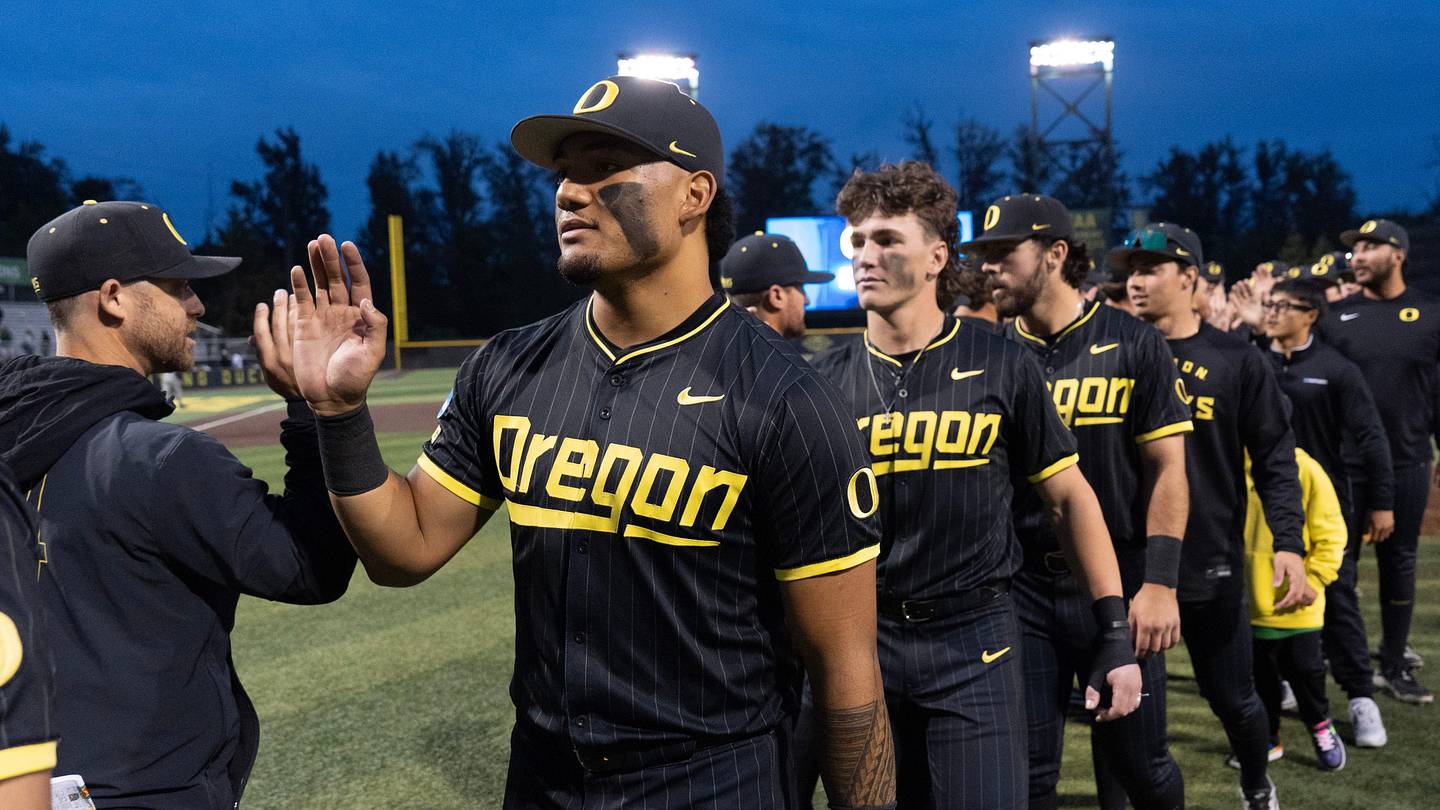
After cruising through the Eugene Regional undefeated, Oregon baseball finally hit its first major road bump of the NCAA Tournament, falling 11-3 to the No. 6 Texas Longhorns in Game 1 of the Austin Super Regional.
The final score was lopsided, but the game itself highlighted a theme that has defined both of these teams throughout the season: one capitalized on opportunities, the other didn’t.
Oregon finished with more hits (9) and more walks (9) than Texas (8 hits, 8 walks), but the Ducks simply could not deliver the timely hit when they needed it most.

Texas, on the other hand, took full advantage of every free base Oregon offered. Between eight walks, three hit batters, and several self-inflicted mistakes on the mound, the Ducks gave the Longhorns far too many opportunities to score. Against a team as talented as Texas, those mistakes rarely go unpunished.
Now the Ducks find themselves one loss away from elimination. West Virginia, Troy, and Ole Miss have already punched their tickets to Omaha, and Oregon was hoping to join that group this weekend. Instead, the Ducks must now win back-to-back games against Texas to keep their College World Series hopes alive.
Winners From Oregon’s Loss to the Texas Longhorns
Texas Pitcher Dylan Volantis:
Texas ace Dylan Volantis delivered exactly the type of postseason performance championship teams need from their Friday night starter. Volantis worked 5.1 scoreless innings while allowing eight hits, striking out 10, walking four, and throwing a career-high 110 pitches. His previous career high had been 107 pitches against Mississippi State on May 1, making his workload against Oregon even more impressive.
What makes Volantis’ outing stand out is the offense he was facing.

Oregon entered the Super Regional with one of the most dangerous lineups in college baseball. The Ducks feature multiple hitters with double-digit home run totals, five regular starters carrying OPS marks above .900, and a lineup capable of beating opponents with both power and speed. Naulivou Lauaki Jr., Drew Smith, Angel Laya, and Brayden Jaksa have fueled an offense that has consistently ranked among the nation’s best.
Yet despite Oregon constantly putting runners on base, Volantis never allowed the Ducks to land the knockout blow. He repeatedly escaped trouble and prevented Oregon from generating the big inning that has carried the Ducks throughout the season. His ability to bend without breaking completely changed the trajectory of the game.
Texas’ Bottom Half of the Lineup
Everyone expected Texas’ stars at the top of the order to contribute. Instead, it was the back half of the lineup that completely took over the game.
The Longhorns’ No. 5–9 hitters combined for eight of the team’s nine RBIs, five runs scored, and three extra-base hits. Adrian Rodriguez led the way with a monster performance, finishing 2-for-3 with five RBIs, including a two-run double in the first inning and two sacrifice flies. By the sixth inning, Rodriguez had already established a career high in RBIs for a single game.

Ethan Mendoza and Casey Borba each added home runs, while Dariyan Pendergrass contributed an RBI. Even Ashton Larson, who didn’t record a hit, drew two walks and helped extend innings.
The production was especially significant considering Oregon actually out-hit Texas. The Longhorns simply made their hits count. Texas turned eight hits into 11 runs because its lineup delivered in run-producing situations. Oregon turned nine hits into just three runs because it couldn’t.
That contrast ultimately decided the game.
Texas Capitalizing on Oregon’s Freebies
Texas deserves significant credit for doing exactly what elite postseason teams are supposed to do: punish mistakes. Oregon’s pitching staff issued eight walks and hit three batters. While only two Texas runs scored directly on a walk or hit batter, the damage went far beyond the runs officially charged to those plays.
The Longhorns consistently turned free baserunners into scoring opportunities. Every walk extended innings. Every hit batter created additional pressure. Every extra opportunity eventually found its way back to the scoreboard.

Against lesser opponents, Oregon has often been talented enough to overcome those mistakes. Against Texas, those mistakes became runs.
Losers From Oregon’s Loss to the Texas Longhorns:
Oregon’s Pitching Staff
Pitching depth has been a discussion point surrounding Oregon throughout the postseason, and it became impossible to ignore Friday night.
Starter Cal Scolari struggled to work efficiently through the Texas lineup. The Longhorns forced him into deep counts early, driving his pitch count to 98 in just 3.2 innings. He finished allowing five earned runs while issuing six walks, hitting one batter, and surrendering a home run.
From there, Oregon was forced into its bullpen earlier than planned. Redshirt freshman Jonah Barkoff entered in the fifth inning but recorded just two outs before the Ducks had to turn to Leo Uelman. Uelman inherited a difficult bases-loaded situation and was immediately tasked with trying to limit the damage.

By the end of the night, Oregon had cycled through five different pitchers.
That formula can work against teams like Yale, where Oregon’s offensive talent advantage often allows the Ducks to survive pitching inconsistencies. The Ducks have enough firepower to outscore mistakes against many opponents. Texas is not one of those opponents.
At this stage of the NCAA Tournament, length from starting pitchers becomes increasingly important. Oregon’s inability to get deep into the game from Scolari forced the Ducks into a difficult bullpen situation almost immediately, and Texas took advantage.
Oregon’s Offense
This might sound strange considering Oregon finished with more hits and more walks than Texas, but the Ducks’ offense was one of the biggest disappointments of the night.
The biggest difference in the game came with runners in scoring position. Oregon finished 0-for-14 in those situations while Texas went 3-for-9.
The Longhorns repeatedly found ways to push runs across, while the Ducks stranded traffic inning after inning. It was a frustrating night for an Oregon offense that spent much of the season overwhelming opponents with a combination of elite power, speed, and patience at the plate.

Oregon finished with more hits and more walks than Texas, yet scored just three runs. The Ducks consistently put themselves in position to score but never delivered the timely hit needed to break the game open.
The Ducks also left 14 runners on base through the first six innings alone.
As frustrating as that number is, it also reflects the nature of Oregon’s offense. This lineup excels at creating traffic. Players like Ryan Cooney and Jax Gimenez consistently find ways to reach base, while Oregon’s power-heavy lineup is built to capitalize with one swing.
The downside is that power-oriented offenses can sometimes become dependent on the big hit. When those hits come, Oregon can score double-digit runs against anyone in the country. When they don’t, innings filled with baserunners suddenly produce very little.
The Sixth Inning Opportunity
If there was ever a moment for Oregon to completely change the game, it came in the sixth inning.
The Ducks loaded the bases with nobody out and suddenly had a realistic path back into the contest. With the amount of power Oregon possesses throughout its lineup, a single swing could have transformed the entire game.

Texas starter Volantis exited the game right before the at-bat, turning things over to the bullpen, but the Ducks came up empty in the biggest spot of the inning.
Oregon eventually pushed across two runs thanks to back-to-back walks and wild pitches from Thomas Burns, cutting into the deficit and creating at least some pressure on the Longhorns.
However, Texas responded immediately. Ethan Mendoza crushed a massive home run later in the inning that pushed the Longhorns’ lead back to eight runs at 10-2, slamming the door shut on any potential comeback.
Sign up to our free newsletter and follow us on Facebook, X and Instagram for the latest news.
 Add us as a preferred source on Google
Follow
#Winners #Losers #Oregons #Super #Regional #Loss #Texas